 GeoGuess
Look-alike flags are told apart by four things: the order of the colours read from the flagpole outwards, the emblem or stars on the cloth, the exact shade, and the shape. Chad and Romania are the one pair that is practically identical, so you need the rest of the photo. Indonesia and Monaco are both red over white, while Poland is white over red. Australia has white stars and New Zealand has red stars with white borders. Ireland has green next to the pole and Ivory Coast has orange there. The Netherlands uses a darker blue than Luxembourg.
In a photo, colour order is the most useful of the four and the easiest to get wrong, because a flag seen from behind is mirrored. Shades shift with sunlight and fading, and shape is lost once the cloth waves. And a correctly identified flag only tells you whose flag it is, not where the photo was taken.
Read a flag from the pole, not from left to right
Every flag has a hoist, the edge attached to the pole, and a fly, the loose edge. Flag laws define the colours from the hoist outwards. The Irish tricolour is green at the hoist, then white, then orange. The flag of Ivory Coast is the same three colours in the reverse order, orange at the hoist.
A flag is printed or sewn through the cloth, so from the far side you see a mirror image. When the wind blows the flag to the left of its pole, the hoist is on the right of the frame and a left to right reading gives you the colours backwards. An Irish flag streaming to the left reads orange, white, green across the photo, which is exactly how Ivory Coast reads on a page. So find the pole first, then read outwards from it.
The same rule settles anything with an emblem near the hoist. The Union Jack on the Australian and New Zealand flags always sits in the corner next to the pole, the shields on the Slovak and Slovenian flags sit towards the hoist, and the Venezuelan state flag carries its coat of arms in the corner nearest the pole. If the Union Jack appears at the top right of the frame, you are looking at the back of the flag.
Flags hung against a wall or down a building are a special case, because they have no pole to read from. Ireland's flag guidelines say that when the tricolour hangs vertically the green goes at the top. Polish law says that when the white and red are shown vertically, the white goes on the left as you look at it. Banners like these are often hung by people who never read the rules, so treat them as weaker evidence than a flag on a pole.
Why a flag is weaker evidence than a sign
A flag tells you whose flag it is. It does not tell you where it is flying. Before you lean on a flag, ask why it might be there:
- Embassies and consulates. The Vienna Convention on Diplomatic Relations gives every mission the right to fly its own country's flag on its premises, the ambassador's residence and the ambassador's car. A capital city photo with a foreign flag on a grand building is often an embassy district.
- Flag rows. Hotels, conference centres, ports, international organisations and memorials fly whole rows of flags. Several different flags in one frame usually mean you are somewhere international, not in each of those countries.
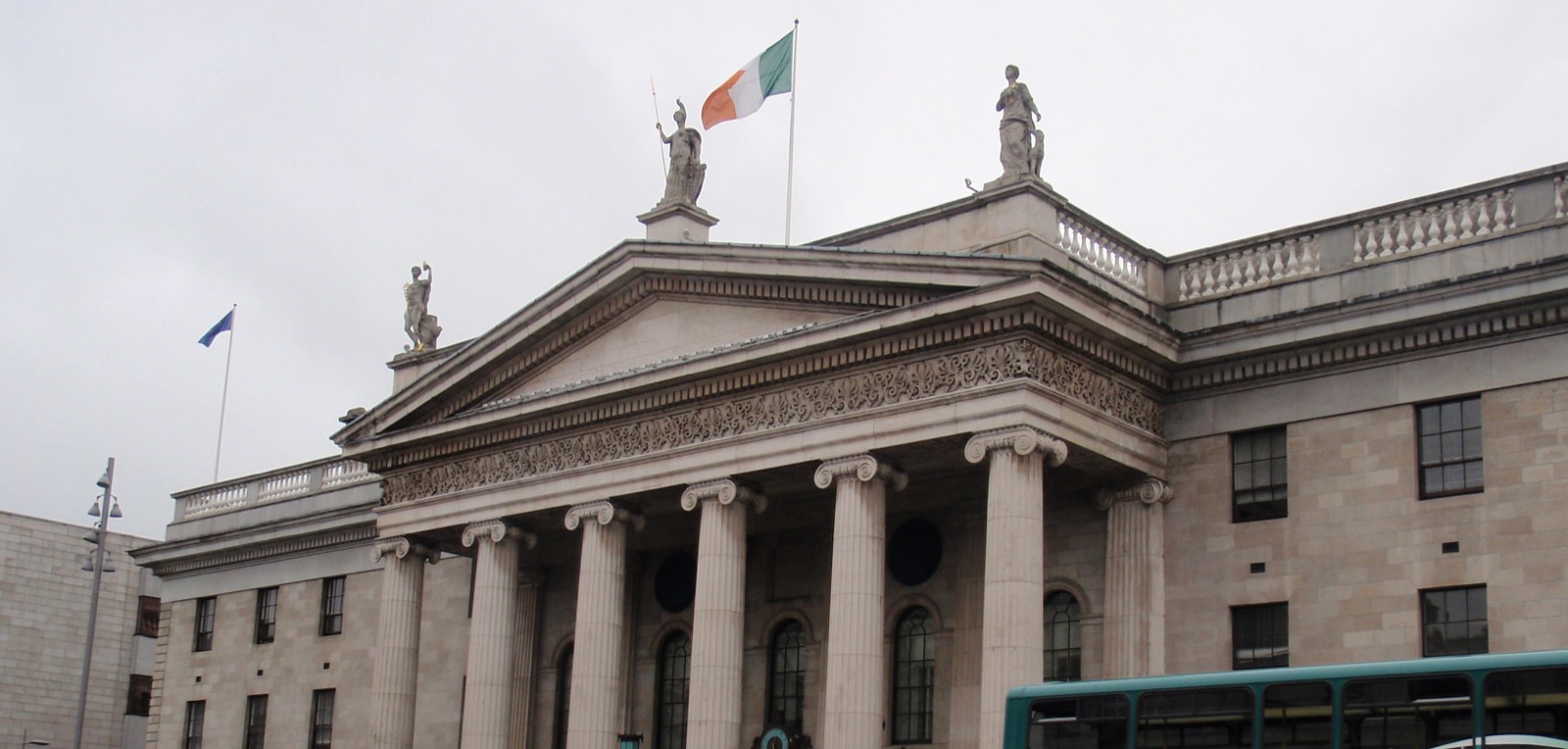
- Flags that are not national. The blue EU flag often flies beside the national flag in EU countries, as on the GPO in Dublin above, and regional and city flags turn up on public buildings everywhere.
- Shops, bars and bunting. Tourist shops sell other countries' flags, pubs hang them for football tournaments, and fans carry them abroad. A row of small flags strung across a street is decoration and can mean almost anything.
- Ships. A merchant ship flies the flag of the country where it is registered, and owners often register ships abroad, so the flag may have nothing to do with the port in the picture.
The flag on a government building, school, town hall or police station is the strongest flag clue, because it is almost always the home country. A flag on a private house is also decent evidence. Even then, check it against something harder to fake: the language on the signs, the licence plates, the driving side or the road markings. The pillar guide on guessing a country from a photo explains how to stack clues like these, and the guide to licence plates by country covers the most reliable of them.
Quick reference table
| Look-alike set | How to tell them apart | What else to check in the photo |
|---|---|---|
| Chad and Romania | Effectively identical vertical blue, yellow, red. Chad's blue is usually described as indigo, a difference you cannot rely on in a photo | Romanian language on signs, EU plates in Romania; French or Arabic signage and Sahel landscape in Chad |
| Andorra and Moldova | Same blue, yellow, red, but with a coat of arms on the yellow band. Andorra's yellow band is slightly wider | Andorra: Catalan signs, Pyrenees. Moldova: Romanian signs, and an eagle holding a shield with an aurochs head on the flag |
| Indonesia and Monaco | Both red over white. Only small differences of shade and shape | Indonesian language and tropical scenery, or French signs and the Mediterranean |
| Poland | White over red, the reverse of Indonesia and Monaco | Polish letters such as ł, ą, ę, ż |
| Singapore | Red over white with a white crescent and five stars at the upper hoist | English, Chinese, Malay and Tamil signs |
| Australia and New Zealand | Both blue with the Union Jack. Australia: six white stars, including a big seven-pointed star under the Union Jack. New Zealand: four red stars outlined in white | Plates: Australia names the state, New Zealand plates have no region |
| Ireland and Ivory Coast | Green, white, orange vs orange, white, green, read from the pole. Ireland is longer (1:2 against 2:3) | English and Irish signs, left-hand traffic in Ireland; French signs and right-hand traffic in Ivory Coast |
| Italy and Mexico | Same green, white, red order. Mexico has an eagle and cactus emblem in the centre; Italy has none | Italian or Spanish on signs |
| Italy and Ireland | Red on Italy where Ireland has orange; Ireland's flag is longer | Driving side: Italy keeps right, Ireland keeps left |
| Hungary and Bulgaria | Horizontal. Hungary is red, white, green from the top; Bulgaria is white, green, red | Hungarian accents ő and ű, or Cyrillic in Bulgaria |
| Netherlands and Luxembourg | Both red, white, blue horizontal. The Netherlands uses a darker red and blue; Luxembourg's blue is a light sky blue and its flag is longer | Dutch signs, or French, German and Luxembourgish. Both use yellow plates, so plates will not split them |
| Norway and Iceland | Mirror images: Norway is red with a white-edged blue cross, Iceland is blue with a white-edged red cross | Norwegian æ, ø, å or Icelandic þ and ð |
| Faroe Islands | White with a blue-edged red cross | Faroese signs with ð |
| Senegal, Mali and Guinea | Senegal is green, yellow, red with a green star. Mali is the same with no star. Guinea is red, yellow, green, Mali reversed | French signs in all three; read from the pole |
| Cameroon | Green, red, yellow with a yellow star on the red band | French and English signs |
| Russia, Slovakia, Slovenia | All white, blue, red horizontal. Russia has no emblem. Slovakia: red shield with a white double cross. Slovenia: blue shield with a white mountain, upper hoist | Cyrillic in Russia; Slovak and Slovene accents |
| Serbia | Red, blue, white, Russia upside down | Cyrillic and Latin both official |
| Venezuela, Colombia, Ecuador | All yellow, blue, red. Venezuela: equal bands and an arc of eight white stars. Colombia and Ecuador: yellow takes the top half. Ecuador adds a coat of arms in the centre | Spanish everywhere, so look at plates, signs and landscape |
The pairs in detail
Chad and Romania
These two are the hardest pair in the world because there is almost nothing to separate. Both are vertical tricolours of blue, yellow and red with no emblem. Romania's dates from the 19th century; Chad adopted its flag in 1959, when Romania's flag still carried a communist emblem, and the two only became near twins when Romania removed that emblem after the 1989 revolution. Chad asked the United Nations to look at the problem in 2004, and Romania said it would not change its flag.
Chad's blue is usually described as indigo, and since 2023 Romanian law has defined its shades exactly, but in a photo you cannot rely on either. Use the setting instead. A blue, yellow and red flag over a building with Romanian signage, EU-format plates or a Carpathian valley is Romania. The same flag with French or Arabic signage and a Sahel or Saharan landscape is Chad. If the flag has an emblem on the yellow band, think of Andorra or Moldova instead.
Indonesia, Monaco and Poland
Indonesia and Monaco both fly a plain bicolour of red over white. Wikipedia describes the differences as a slight change of shade and a different shape, and neither survives a waving flag in a holiday snap. Indonesia's flag, the Sang Saka Merah Putih, was first raised at the independence proclamation of 17 August 1945, and Indonesians are expected to fly it on Independence Day each year, so a street full of red and white in a tropical setting points strongly to Indonesia. Monaco is a tiny city state on the French Riviera, with Mediterranean light, French signage and dense hillside buildings.
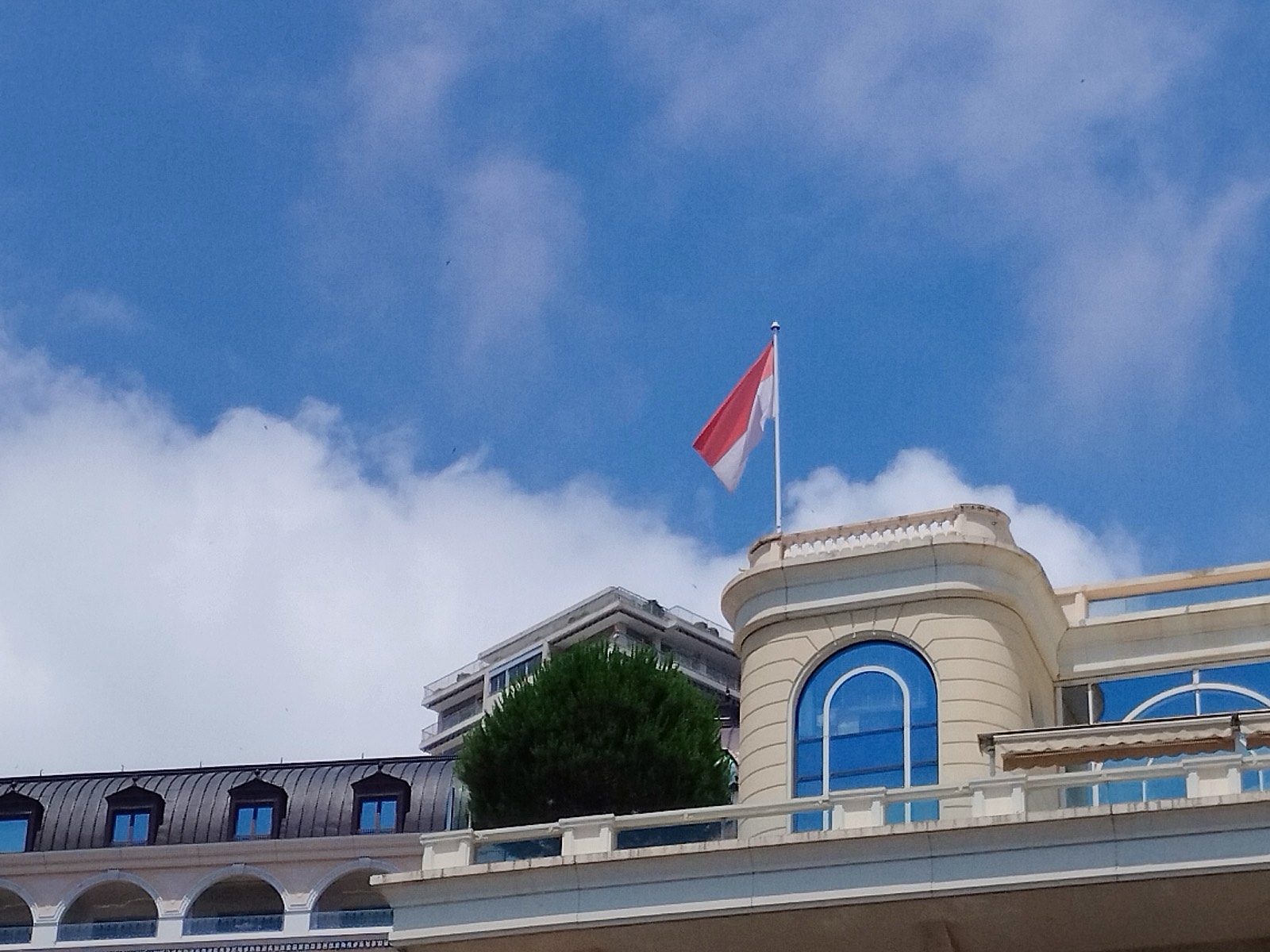
Poland is the same two colours the other way up: white on top, red underneath. It is easy to get wrong when the flag is twisted, so find the top edge where the cloth meets the pole. A Polish flag with the coat of arms, a white eagle on a red shield, in the white band is the variant reserved for official use abroad and at sea. Singapore is also red over white but adds a white crescent and five stars near the hoist.
Australia and New Zealand
Both flags are a dark blue field with the Union Jack in the corner next to the pole, and both show the Southern Cross. The Australian flag has six white stars: the large seven-pointed Commonwealth Star under the Union Jack, plus the five stars of the Southern Cross on the fly, one of them small. The New Zealand flag has only four stars, and they are red with white borders, with no star under the Union Jack.
The quickest check is the big white star below the Union Jack. If it is there, it is Australia. If the fly has a few red points and nothing under the Union Jack, it is New Zealand.
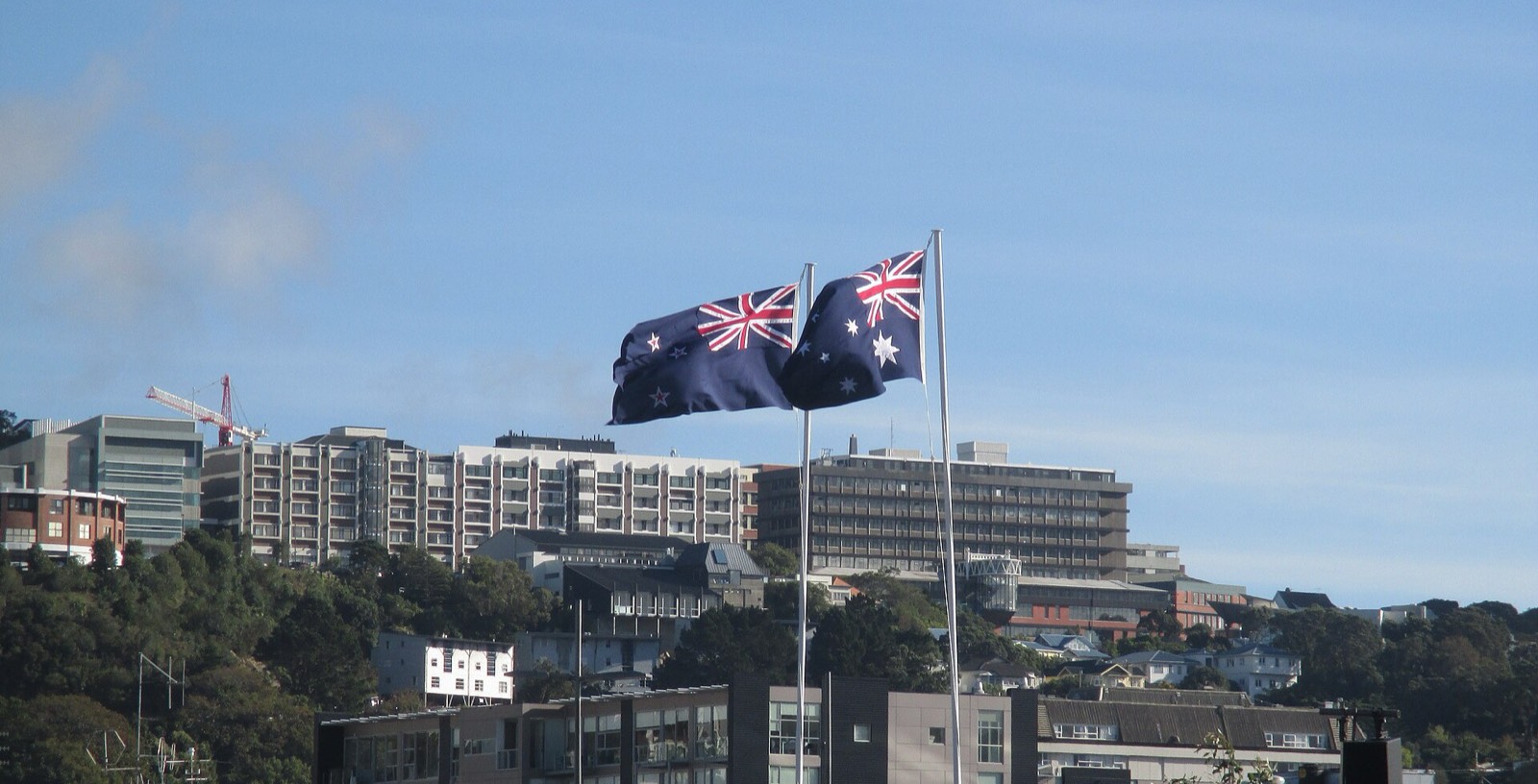
The photo also shows why setting matters: this is New Zealand, and the Australian flag is there only because the memorial is Australian. Licence plates are more reliable: Australian plates carry the state name, New Zealand plates have no region on them.
Ireland, Ivory Coast and Italy
Ireland is green, white and orange from the hoist; Ivory Coast is orange, white and green. The two have been confused often enough that loyalists in Northern Ireland have burned Ivorian flags by mistake, and an Ivorian sprinter once celebrated a world title with a borrowed Irish flag held the other way round. The Irish flag is also longer: its proportions are 1:2, while Ivory Coast's are 2:3. In a photo, the pole is the deciding clue, as described above, and the driving side helps: Ireland keeps left, Ivory Coast keeps right.
Italy uses green, white and red in the same order as Ireland, with red where Ireland has orange. In strong sunlight or on a faded flag, that difference can be small. Mexico has the same order as Italy but adds its coat of arms in the centre: an eagle on a cactus eating a snake. It is also longer than the Italian flag. Hungary uses the same three colours as Italy, but in horizontal stripes, red on top.
Netherlands and Luxembourg
Both are horizontal red, white and blue. The Dutch flag uses darker shades of red and blue and is shorter. Luxembourg's law defines its blue as a light, bright blue, and its flag is longer. Side by side the difference is easy to see; on its own, in flat light, it is not.
Luxembourg is also unusual in using a second, completely different flag: the Red Lion, a red lion on blue and white stripes. It is the official ensign for Luxembourg ships and aircraft, and sports fans often wave it instead of the national flag. Inland Luxembourg has French, German and Luxembourgish signs, while the Netherlands is overwhelmingly Dutch, which the guide to Latin alphabet letters by language helps you pick out.
Norway, Iceland and the Faroe Islands
These are Nordic cross flags, with the vertical bar of the cross shifted towards the hoist. Norway is red with a blue cross edged in white. Iceland is the reverse: sky blue with a red cross edged in white. The Faroe Islands use a white field with a red cross edged in blue. Remember the field colour, the large areas in the corners, and you have the country.
Senegal, Mali, Guinea and Cameroon
West Africa has several flags built from the same pan-African green, yellow and red. Senegal is a vertical green, yellow, red tricolour with a green five-pointed star in the centre. Mali is the same three stripes with no star. Guinea is the same colours in the reverse order, red at the hoist, so a Malian flag seen from behind looks Guinean. Cameroon puts red in the middle, green, red, yellow, with a yellow star on the red band.
Chad was nearly part of this group. Its first proposed flag in 1959 was green, yellow and red, and the green was changed to blue to avoid confusion with Mali, which is how it ended up resembling Romania instead.
Russia, Slovakia, Slovenia and Serbia
Russia, Slovakia and Slovenia all fly white, blue and red horizontal stripes, in that order from the top. Russia's flag has no emblem. Slovakia adds its coat of arms towards the hoist: a red shield with a white double cross standing on three blue hills. Slovenia's coat of arms is a blue shield in the upper hoist, straddling the white and blue stripes, showing the white peak of Mount Triglav under three gold stars. Serbia uses the same colours turned upside down, red, blue and white from the top.
When the emblem is too small to see, look at the writing. Cyrillic points to Russia (or Serbia), while Slovak and Slovene use Latin letters with háčeks, for example č, š and ž.
Venezuela, Colombia and Ecuador
All three share yellow, blue and red, inherited from the flag of Gran Colombia. Venezuela has three equal stripes with an arc of eight white stars on the blue; the state version adds a coat of arms in the corner near the pole. Colombia gives yellow the top half of the flag, with blue and red a quarter each. Ecuador uses the same 2:1:1 stripes as Colombia and adds its coat of arms in the centre. A plain Ecuadorian flag without the arms, the version merchant ships must fly, looks just like Colombia's, which is why Ecuadorians often fly the version with the coat of arms.
So: equal stripes and stars mean Venezuela, a wide yellow band and nothing else usually means Colombia, and a wide yellow band with an emblem in the middle means Ecuador.
Quick checklist
- Find the pole. Read the colours outwards from the hoist. If the pole is on the right of the frame, with the Union Jack or a shield next to it at the right, you are looking at the back of the flag.
- Look for an emblem. Stars, shields, crowns and eagles break almost every tie: Senegal from Mali, Slovakia and Slovenia from Russia, Mexico from Italy, Ecuador from Colombia.
- Count and colour the stars. White stars with a big one under the Union Jack is Australia; four red stars is New Zealand.
- Treat shade and shape as weak hints. Light blue for Luxembourg, a long flag for Ireland, but cameras, sunlight and old cloth all shift colours.
- Ask why the flag is there. Embassies, hotels, flag rows, shops, fans and ships all fly foreign flags.
- Confirm with something else. A sign, a licence plate, the driving side or the landscape should agree with the flag before you commit. Chad and Romania cannot be split any other way.
Practice
You can play a free round as a guest at /try, no account needed, and every country page has its own round too, for example Ireland or Romania, so you can practise reading flags alongside the signs and plates that confirm them.