 GeoGuess
You can usually place a licence plate (a license plate, if you are in the US) in two steps: first its shape and colour, which give you the continent, then one detail such as a country code, a band or a word, which gives you the country. A long, thin white plate with a blue band on the left is European. A yellow plate at both ends of the car means the Netherlands or Luxembourg. A white plate at the front and a yellow one at the back is the British pattern. A short, square-ish plate with a state name is North American, and a white plate with a blue strip across the top is from the Mercosur bloc in South America.
Plates are one of the best clues in a photo because they are designed to be read at a distance, they follow strict national rules, and almost every street scene has a parked car somewhere. Even when the characters are too small to read, the colours and proportions usually survive.
Start with the shape
Before you look for any letters, look at the outline of the plate. Three shapes cover most of the cars you will see.
| Shape | Typical size | Where it points |
|---|---|---|
| Long and thin | 520 mm by 110 or 120 mm | Europe |
| Short and tall | 300 mm by 150 mm (12 by 6 inches) | United States, Canada, Mexico |
| Medium, with a band across the top | 400 mm by 130 mm | Mercosur: Brazil, Argentina, Uruguay, Paraguay |
| Small and nearly square | 330 mm by 165 mm | Japan |
Shape alone is not a final answer. Some European plates come in a squarer two-line format, such as the tall rear plate many Swiss cars carry, and plenty of countries outside these groups use their own sizes. But it narrows the field in a second, and it still works when the plate is blurred.
Europe: the blue band
Most European plates share one design: black characters on a white background, with a blue band at the left end carrying the twelve yellow stars of the EU and a short country code. The band is the quickest win in the whole guide, because you can often read the code when the rest of the plate is a blur.
| Code | Country | Code | Country |
|---|---|---|---|
| A | Austria | IRL | Ireland |
| B | Belgium | L | Luxembourg |
| D | Germany | NL | Netherlands |
| DK | Denmark | P | Portugal |
| E | Spain | PL | Poland |
| F | France | S | Sweden |
| I | Italy | FIN | Finland |
Some countries outside the EU copy the band without the stars. Serbia, Montenegro, Bosnia and Herzegovina, North Macedonia and Turkey use a plain blue band with just the code. Norway has used a blue band carrying the Norwegian flag and the letter N on plates made since November 2006. Ukraine puts UA in a band in the national colours at the left end. In the United Kingdom, plates that carry a national identifier have shown UK rather than GB since September 2021, and they never show the EU stars.
Yellow plates, and why front and rear can differ
Colour is the second big filter, and in Europe it mostly means yellow. The trick is to check both ends of the car if you can, because some countries use a different colour at the front and the back.
| Country or territory | Front plate | Rear plate |
|---|---|---|
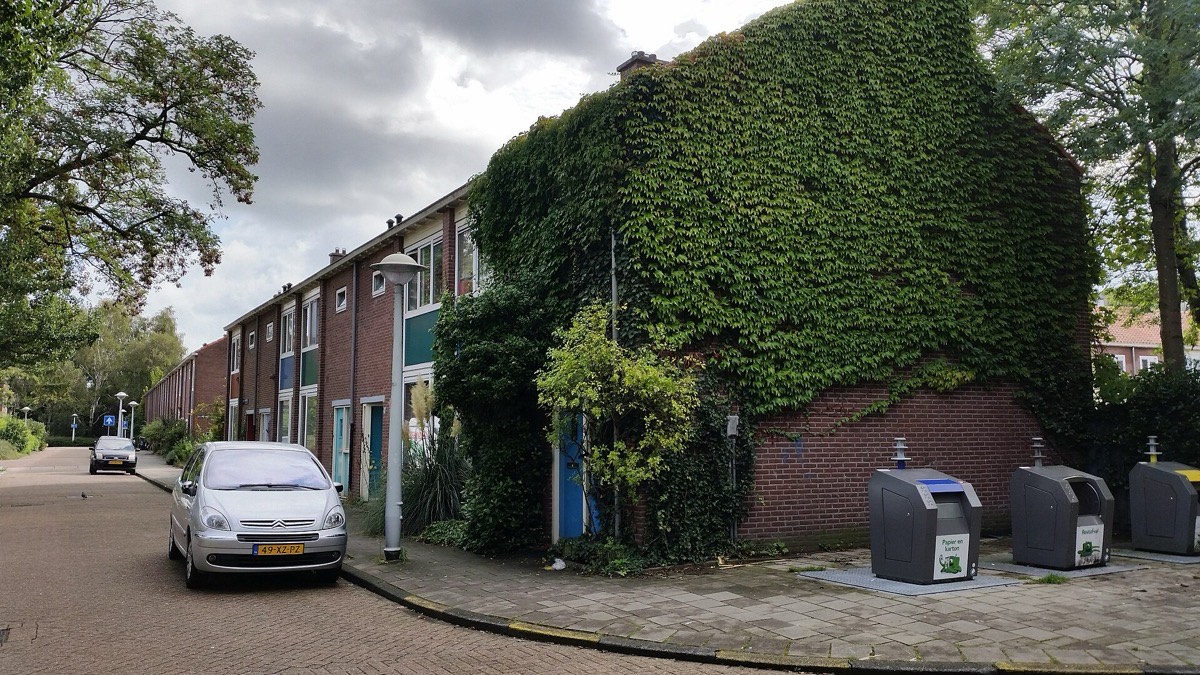
| Netherlands | Yellow | Yellow |
| Luxembourg | Yellow | Yellow |
| Israel | Yellow | Yellow |
| United Kingdom | White | Yellow |
| Gibraltar | White | Yellow |
| Hong Kong | White | Yellow |
| France (current plates) | White | White |
| Most other European countries | White | White |
So if a car has yellow plates at both ends and drives on the right, you are almost certainly in the Netherlands or Luxembourg, both of which use black characters on yellow with the EU band. Israel is the other big yellow-plate country: black characters on yellow at both ends, with a blue band showing the Israeli flag and the letters IL. If the front is white and the back is yellow, think of the United Kingdom first, then Gibraltar and Hong Kong. Our guide to countries that drive on the left covers the other places that pair a white front with a yellow rear.
Yellow at the back of a French car is a historical clue, not a current one. France used yellow rear plates for decades, and the current system, introduced in 2009, uses white at both ends. An older car with a yellow rear plate can still turn up, but most French plates you see will be white.
Elsewhere in Europe, yellow usually marks a type of vehicle rather than a country. Danish and Hungarian commercial vehicles use yellow plates, and several countries, including Greece, Cyprus, Latvia, Lithuania and Sweden, use yellow for taxis. That is why a single yellow van in an otherwise white-plated street should not send you straight to Amsterdam.
European plates that bend the template
Once you know a plate is European, a handful of national twists can pin down the country even without reading the code.
- Italy has a blue band at both ends. The right-hand band shows the year of issue and, optionally, a two-letter province code.
- France also has a right-hand band, but it shows a département number and the logo of the region. Owners can choose which département to display, so it tells you about the driver's attachment, not necessarily where they live. The current format is two letters, three numbers and two letters, as in AB-123-CD.
- Portugal used a yellow strip on the right showing the year and month of registration, but dropped it for plates issued since March 2020. Older cars still carry it.
- Belgium uses dark red characters on white instead of black.
- Austria has red and white bands along the top and bottom edges of the plate.
- Ireland prints the county name in Irish above the number.
- Denmark uses black characters on white with a red border, normally two letters followed by five digits. The EU band is optional.
- Switzerland has no blue band at all, which is why Swiss cars abroad carry a separate oval CH sticker. Plates show a two-letter canton code and up to six digits, and the rear plate adds the Swiss shield and the canton's coat of arms. The front plate is a small 300 mm by 80 mm strip.
- Russia has no band on the left. The code RUS, the flag and a region number sit together in a box at the right end.
Japan: small plates and the kei yellow
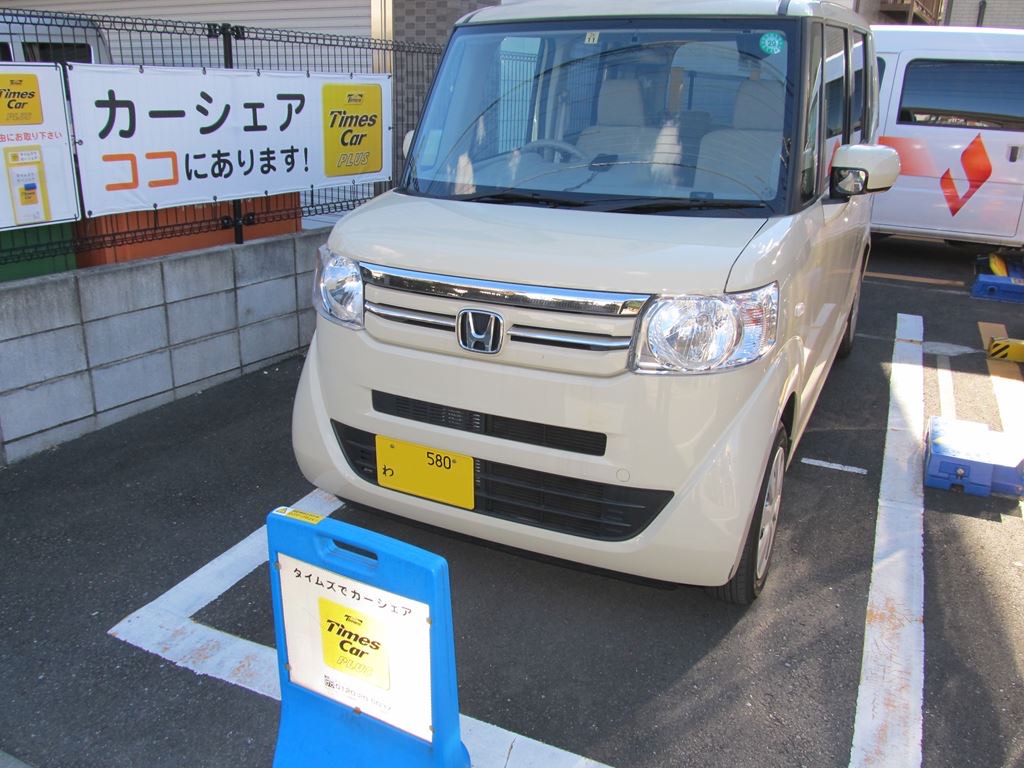
Japan is the easiest plate country in Asia once you know the four colour schemes. Japanese car plates are small, 330 mm by 165 mm for most vehicles, fitted front and rear, and laid out on two lines. The top line names the issuing office in kanji and adds a class number; the bottom line has a single hiragana character followed by a four-digit number split by a hyphen.
| Vehicle | Background | Characters |
|---|---|---|
| Private car | White | Green |
| Commercial vehicle | Green | White |
| Private kei car | Yellow | Black |
| Commercial kei vehicle | Black | Yellow |
Kei cars are Japan's tiny car class, limited to 3.4 metres long, 1.48 metres wide and an engine under 660 cc. They are everywhere in Japan, so a yellow plate on a small, boxy car is close to a giveaway. Two caveats: kei owners could order the white special-edition plates issued for the 2019 Rugby World Cup and the Tokyo 2020 Games, and the regional picture plates introduced in 2018 give kei cars a thin yellow border instead of a yellow background. A white plate does not rule a kei car out, but a plain yellow one strongly points to Japan.
North America: state names and rear-only plates
Plates in the United States, Canada and Mexico share the same 12 by 6 inch shape, set by an agreement between US states, Canadian provinces and carmakers in 1956. Inside that shape, every state and province designs its own plate, so the colours vary enormously. What they share is the name of the issuing state or province, and very often a slogan or a background picture.
The most useful clue is not the design but whether the car has a front plate at all.
| Country | Front plate rule |
|---|---|
| United States | 22 states require only a rear plate, including Florida, Georgia, Michigan, Ohio, Pennsylvania and North Carolina. California, New York, Texas, Illinois and others require both |
| Canada | Only British Columbia, Manitoba and Ontario require front and rear plates. Quebec, Alberta and the rest require only a rear plate |
| Mexico | Plates are issued as a front and rear pair |
A car with an empty front bumper in a North American scene therefore rules out a good chunk of the continent, and a front plate in a city full of them rules out the rear-only states. Ohio dropped its front plate in 2020 and Utah in 2025, so this rule changes from time to time. Slogans can settle the rest when they are legible: Maine's "Vacationland", Illinois's "Land of Lincoln", Quebec's "Je me souviens", Ontario's "Yours to Discover" and British Columbia's "Beautiful British Columbia". The Northwest Territories even issues a plate shaped like a polar bear.
Latin America: the Mercosur plate
In South America, look for a white plate with a blue band across the top. This is the common Mercosur design: 400 mm by 130 mm, black characters on white, with the band carrying the country name, its national flag and the Mercosur logo. Uruguay adopted it in 2015, Argentina in 2016, Brazil from September 2018 and Paraguay in July 2019. Venezuela's adoption was suspended, and Bolivia uses it only for vehicles in international transport.
The country name in the band is usually readable even at low resolution, but the flag colours help too: green and yellow for Brazil, light blue and white for Argentina and Uruguay, red, white and blue for Paraguay.
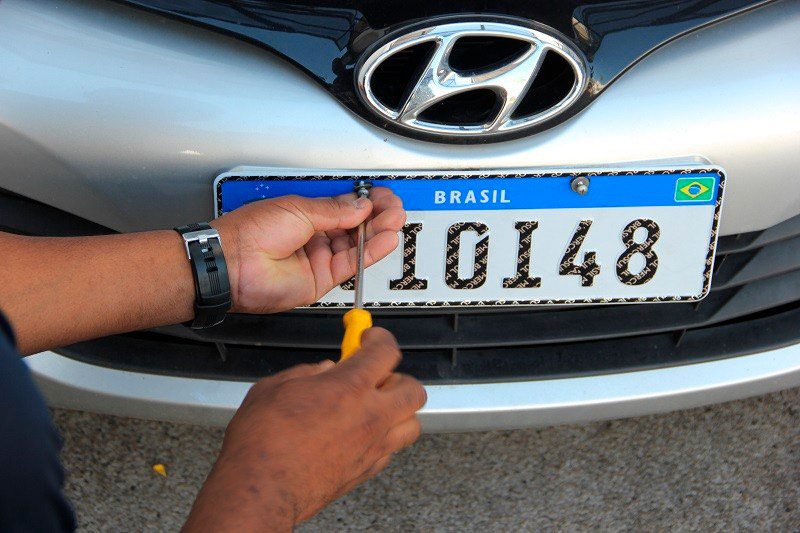
Brazil adds a useful twist. The background is always white, but the character colour marks the vehicle category: black for private cars, red for paid transport and driving schools, blue for official vehicles, green for manufacturer and dealer testing, and gold for diplomats. A red-lettered Mercosur plate on a taxi or a bus is Brazilian.
Older plates still circulate in all four countries, so a missing band is not proof you are outside Mercosur. Brazil's previous plates were grey with dark characters and a metal strip showing the state and city. Argentina's pre-2016 plates are black with white characters and the word Argentina at the top.
Chile stays outside the scheme. Its plates are black characters on white, 360 mm by 130 mm, with four letters and two numbers and the word CHILE along the bottom.
Australia and New Zealand
Australian plates vary by state and territory, and most print the state name and often a slogan along the bottom. That makes them easier to place than they first look.
| State or territory | Standard plate | Text on the plate |
|---|---|---|
| New South Wales | Black characters on yellow | NEW SOUTH WALES |
| Victoria | Blue characters on white | VICTORIA, THE EDUCATION STATE |
| Queensland | Maroon characters on white | QUEENSLAND, SUNSHINE STATE |
| South Australia | Black characters on white | SOUTH AUSTRALIA |
| Western Australia | Blue characters on white | WESTERN AUSTRALIA |
| Tasmania | Blue characters on white | Tasmania, Explore the possibilities |
| Northern Territory | Ochre characters on white | N.T OUTBACK AUSTRALIA |
| Australian Capital Territory | Blue characters on white | Canberra slogans |
A yellow plate in a left-driving country with eucalyptus by the road is a strong sign of New South Wales. New Zealand is the opposite: plates are plain black characters on white with no region shown, which is itself a good way to tell it apart from Australia.
Elsewhere: Asia, Africa and the Middle East
- Israel: yellow front and rear, black characters, eight digits in the pattern 123-45-678, and a blue band with the flag and IL.
- Hong Kong: white at the front and yellow at the rear, like the UK, with two letters followed by up to four digits.
- India: private cars carry black characters on white and commercial vehicles black on yellow. Electric vehicles are green, with white characters for private and yellow for commercial. The plate starts with a two-letter state code, such as MH or DL.
- China: ordinary cars carry white characters on a blue plate, and large vehicles black on yellow. New energy vehicles get green plates. Every plate starts with a single Chinese character for the province.
- Thailand: private cars carry black characters on white, written in Thai script, with the province name in Thai underneath the number.
- South Africa: each province has its own design and a suffix code, such as GP for Gauteng, ZN for KwaZulu-Natal and MP for Mpumalanga. Gauteng plates have blue characters and the provincial coat of arms, Northern Cape plates have green characters and a gemsbok, and Western Cape plates are plain black on white.
Green is worth one more note. In India and China a green plate means an electric or new energy vehicle, in Norway it marks vans and small trucks in a lighter tax class, and in the Netherlands it marks trade plates. The colour alone does not identify a country, so read it together with the script on the plate.
Quick checklist
Run through this in order and stop when two clues agree.
- Shape. Long and thin is Europe or Israel; 12 by 6 inches is North America; medium with a top band is Mercosur; small and square is Japan.
- Left-hand band. Read the code. A band with no stars means a non-EU country such as Serbia, Turkey or Norway.
- Colour, both ends. Yellow and yellow: Netherlands, Luxembourg or Israel. White and yellow: UK, Gibraltar or Hong Kong. Yellow on a small car in Japan: a kei car.
- Second band or box on the right. Blue on the right: Italy or France. A box with RUS: Russia.
- Words. A state name in North America or Australia, a country name in the Mercosur band, a province in Thai script.
- Front plate missing? In North America that is a rear-only state or most Canadian provinces.
- Cross-check. Confirm with the driving side, the script on shop signs and the road markings, as in our pillar guide to guessing a country from a photo.
Practice
The plate rules stick fastest when you test them on real photos. Play a free round as a guest at /try, no account needed, and make a habit of finding the nearest car before you look at anything else. Each country page also has its own round, for example the Netherlands or Japan, so you can drill one plate style at a time.