 GeoGuess
Read the everyday sign words rather than the letters: exit, pharmacy, bakery, square and the open or closed card on the shop door. Close languages share most of their letters, but they almost never spell all of those words the same way, so two or three of them on one photo are usually enough to name the language and, from there, the country.
This page assumes you already know the special letters. If a sign shows ñ, ø, ř or ő, start with which language uses which letters, which settles many signs on its own. What follows is for the harder case: two languages with the same alphabet, or a sign with no special letter at all. Each table lists the word as it is usually printed on the sign itself, so closed appears as the short form on a shop door, not the dictionary headword.
How to use the tables
Look for the short, repeated words first. Exit and entrance signs, pharmacy fascias, opening hours boards and street plates are everywhere, they are standardised, and their spelling rarely changes between towns. Long advertising slogans are harder to read and more likely to be in English.
Opening hours are an underrated clue. Day names are abbreviated differently in almost every language, even between very close neighbours, so a board reading Seg to Sex tells you something that Lun to Vie does not.
Finally, remember that a word can be shared. Czech and Slovak both write východ for exit, and Dutch and Afrikaans both write uitgang. When a word appears in two columns, it narrows the field but does not decide it, so look for a second word.
Spanish, Portuguese, Catalan, Galician and Italian
These five share a Latin vocabulary, so the same word often appears in five slightly different spellings. That is exactly what makes them readable.
| Sign word | Spanish | Portuguese | Catalan | Galician | Italian |
|---|---|---|---|---|---|
| Exit | Salida | Saída | Sortida | Saída | Uscita |
| Street | Calle | Rua | Carrer | Rúa | Via |
| Square | Plaza | Praça | Plaça | Praza | Piazza |
| Pharmacy | Farmacia | Farmácia | Farmàcia | Farmacia | Farmacia |
| Bakery | Panadería | Padaria | Forn, Fleca | Panadaría | Panificio, Forno |
| Open | Abierto | Aberto | Obert | Aberto | Aperto |
| Closed | Cerrado | Fechado | Tancat | Pechado | Chiuso |
| And | y | e | i | e | e |
| Ending for "-tion" | -ción | -ção | -ció | -ción | -zione |
| Thursday | jueves | quinta-feira | dijous | xoves | giovedì |
Spain vs Portugal. Spanish writes ñ and ll where Portuguese writes nh and lh, and Portuguese ends hundreds of words in -ção where Spanish has -ción. The opening hours board is the fastest test. Portuguese numbers its weekdays, so segunda-feira is Monday and sexta-feira is Friday, and a board reading Seg, Ter, Qua, Qui, Sex is Portuguese. Spanish boards run Lun, Mar and so on to Vie. Brazil shares the Portuguese words above, though some everyday words differ: a bus is ônibus in Brazil and autocarro in Portugal.
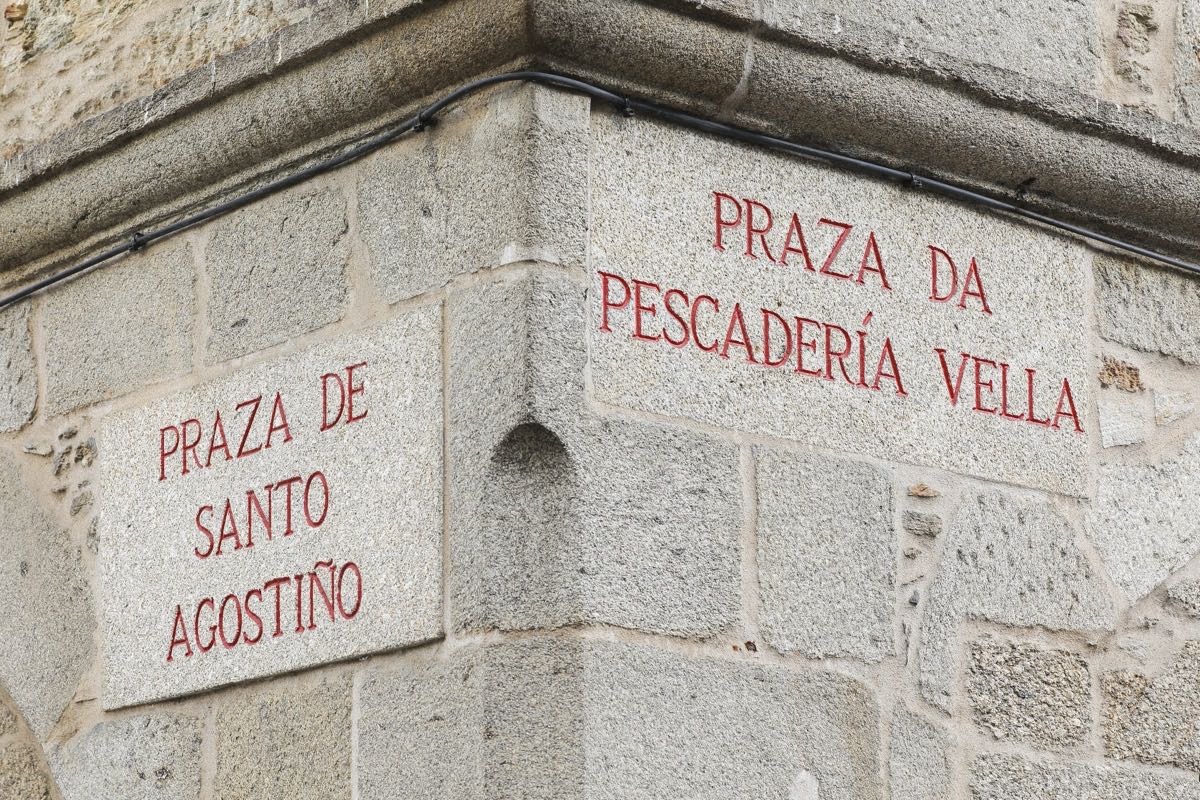
Galician vs Portuguese. This is the closest pair here: both say saída for exit and aberto for open. Look for the spelling instead. Galician writes rúa with an accent and praza with a z, never praça. It uses ñ and ll, as in Agostiño and vella, where Portuguese writes Agostinho and velha, and its official spelling has no ç at all. Galician says pechado for closed, not fechado, and it usually names its weekdays luns, martes, mércores, xoves and venres rather than counting them. Galicia is in Spain, so Spanish signs sit alongside the Galician ones. A minority of Galician writers follow a spelling closer to Portuguese, with lh, nh and ç, but official signage does not.
Catalan vs Spanish. Carrer and plaça are the giveaways on street plates, sortida on exits and tancat on closed shops. Catalan writes ny where Spanish writes ñ (Catalunya against Cataluña), joins words with i instead of y, and ends -ció without the n. In Valencia the exit word can be eixida instead of sortida. Catalan is the official language of Andorra and co-official in Catalonia, Valencia and the Balearic Islands.
Italy. Via and piazza on the street plates, uscita on exits and chiuso on the door are enough. Italian also writes gn for the sound Spanish writes ñ, and doubled consonants such as the zz of piazza are far more common than in the Iberian languages.
Danish, Norwegian and Swedish
Danish and Norwegian share an alphabet, and Swedish differs only in writing ä and ö for æ and ø. The words split them anyway.
| Sign word | Danish | Norwegian (Bokmål) | Swedish |
|---|---|---|---|
| Exit | Udgang | Utgang | Utgång |
| Entrance | Indgang | Inngang | Ingång |
| Opening hours | Åbningstider | Åpningstider | Öppettider |
| Open | Åbent | Åpent | Öppet |
| Closed | Lukket | Stengt | Stängt |
| Bakery | Bageri | Bakeri | Bageri |
| Town centre | Centrum | Sentrum | Centrum |
| Square | Torv | Torg | Torg |
| Street | gade | gate | gata |
| Saturday, Sunday on hours boards | Lør., Søn. | Lø., Sø. | Lör, Sön |
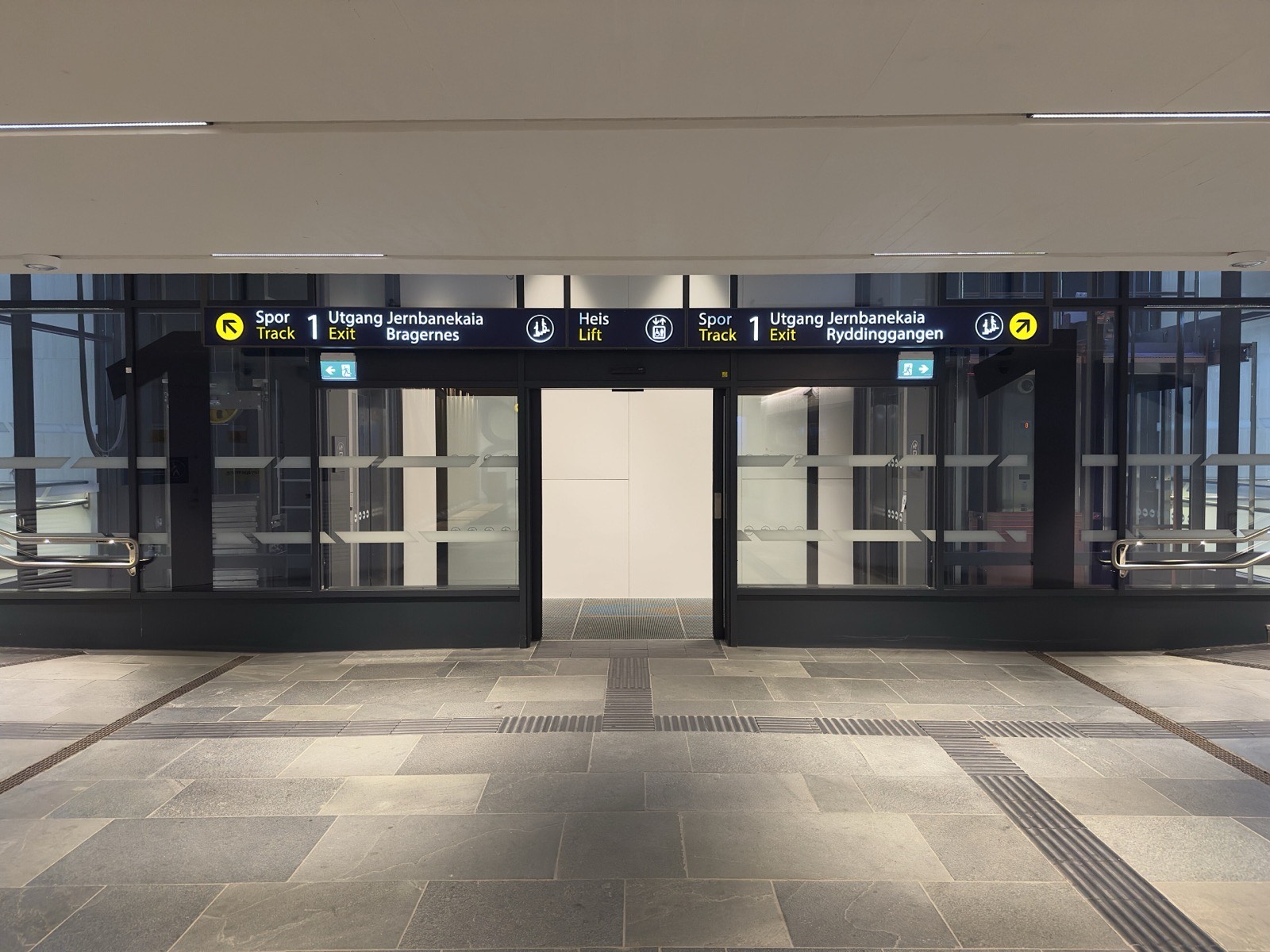
Denmark vs Norway. Danish keeps a b, d or g where Norwegian has p, t or k, and the exit sign shows it: udgang against utgang. Danish writes b in åbent and åbningstider where Norwegian writes p. Norwegian doubles the n in inngang. Sentrum with an s is a strong Norwegian tell, because Danish and Swedish both write centrum. Stengt on a door points to Norway, but lukket is not proof of Denmark, because Norwegian uses that word for closed too.
Sweden. Swedish is the easiest of the three once you see one ä or ö, but the vocabulary confirms it: utgång with å, öppet and stängt on the door, and öppettider on the hours board instead of a word built on åbning or åpning. Note that bageri and centrum are spelled the same in Danish and Swedish, so those two words alone never separate them.
Croatian, Serbian, Bosnian and Slovenian
Croatian, Serbian, Bosnian and Montenegrin are close enough to share most sign words, so the clue is often a single sound. Croatian, Bosnian and Montenegrin use the ijekavian pronunciation, written ije or je, while most of Serbia uses the ekavian e. That is why Croatia writes mlijeko for milk and ponedjeljak for Monday, where a sign in Serbia says mleko and ponedeljak. Slovenian is a separate language, and the letters guide explains how its alphabet lacks ć and đ.
| Sign word | Croatian | Serbian (Latin) | Bosnian | Slovenian |
|---|---|---|---|---|
| Pharmacy | Ljekarna | Apoteka | Apoteka | Lekarna |
| Exit | Izlaz | Izlaz | Izlaz | Izhod |
| Entrance | Ulaz | Ulaz | Ulaz | Vhod |
| Open | Otvoreno | Otvoreno | Otvoreno | Odprto |
| Closed | Zatvoreno | Zatvoreno | Zatvoreno | Zaprto |
| Train | Vlak | Voz | Voz | Vlak |
| Bread | Kruh | Hleb | Hljeb | Kruh |
| Monday | Ponedjeljak | Ponedeljak | Ponedjeljak | Ponedeljek |
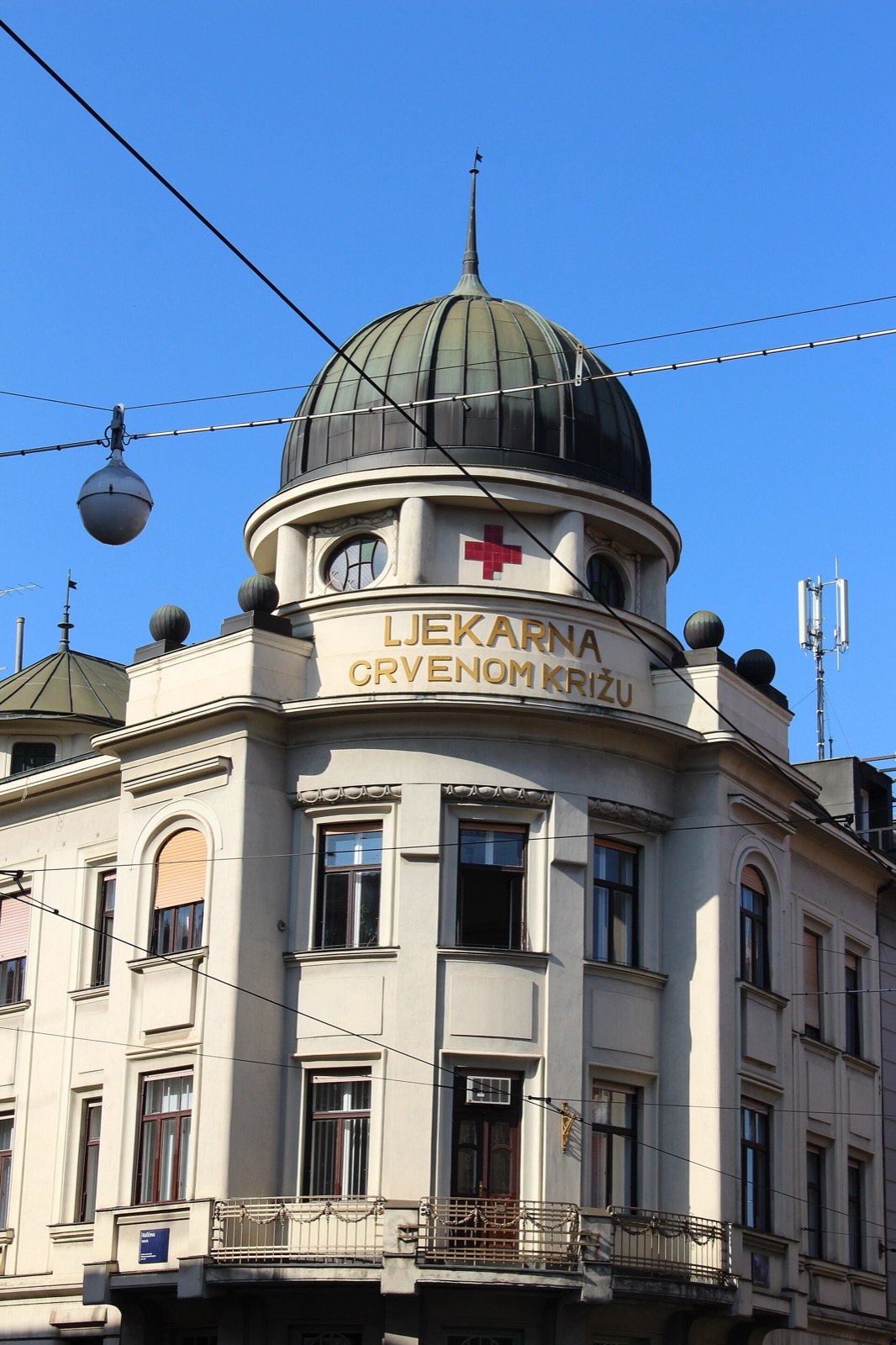
Croatia vs Serbia. Ljekarna on a green-cross fascia is Croatian; apoteka is the Serbian and Bosnian word. Railway stations in Croatia are signed kolodvor (Glavni kolodvor in Zagreb), a word Slovenian uses too. Serbia also uses Cyrillic officially, so a sign in Cyrillic beside Latin text points away from Croatia.
Bosnia and Herzegovina. Bosnian sits between the two: ijekavian like Croatian (hljeb, ponedjeljak) but often with the Serbian word choice (voz, apoteka). Expect all three standards on signs there, and Cyrillic in parts of the country.
Slovenia. Izhod and vhod on doors, odprto and zaprto on shops and lekarna without the j are all Slovenian. The opening hours board also helps: Slovenia abbreviates Tuesday as TOR, Croatia as Uto.
Czech and Slovak
Both use č, š, ž and the acute accent, and the letters guide lists the handful of letters that only one of them has. When none of those shows up, these words do the work.
| Sign word | Czech | Slovak |
|---|---|---|
| Pharmacy | Lékárna | Lekáreň |
| Bakery | Pekárna | Pekáreň |
| Square | Náměstí | Námestie |
| Street | Ulice | Ulica |
| Open | Otevřeno | Otvorené |
| Closed | Zavřeno | Zatvorené |
| Exit | Východ | Východ |
| Entrance | Vchod | Vchod |
| Tuesday, Thursday, Friday on hours boards | Út, Čt, Pá | Ut, Št, Pi |
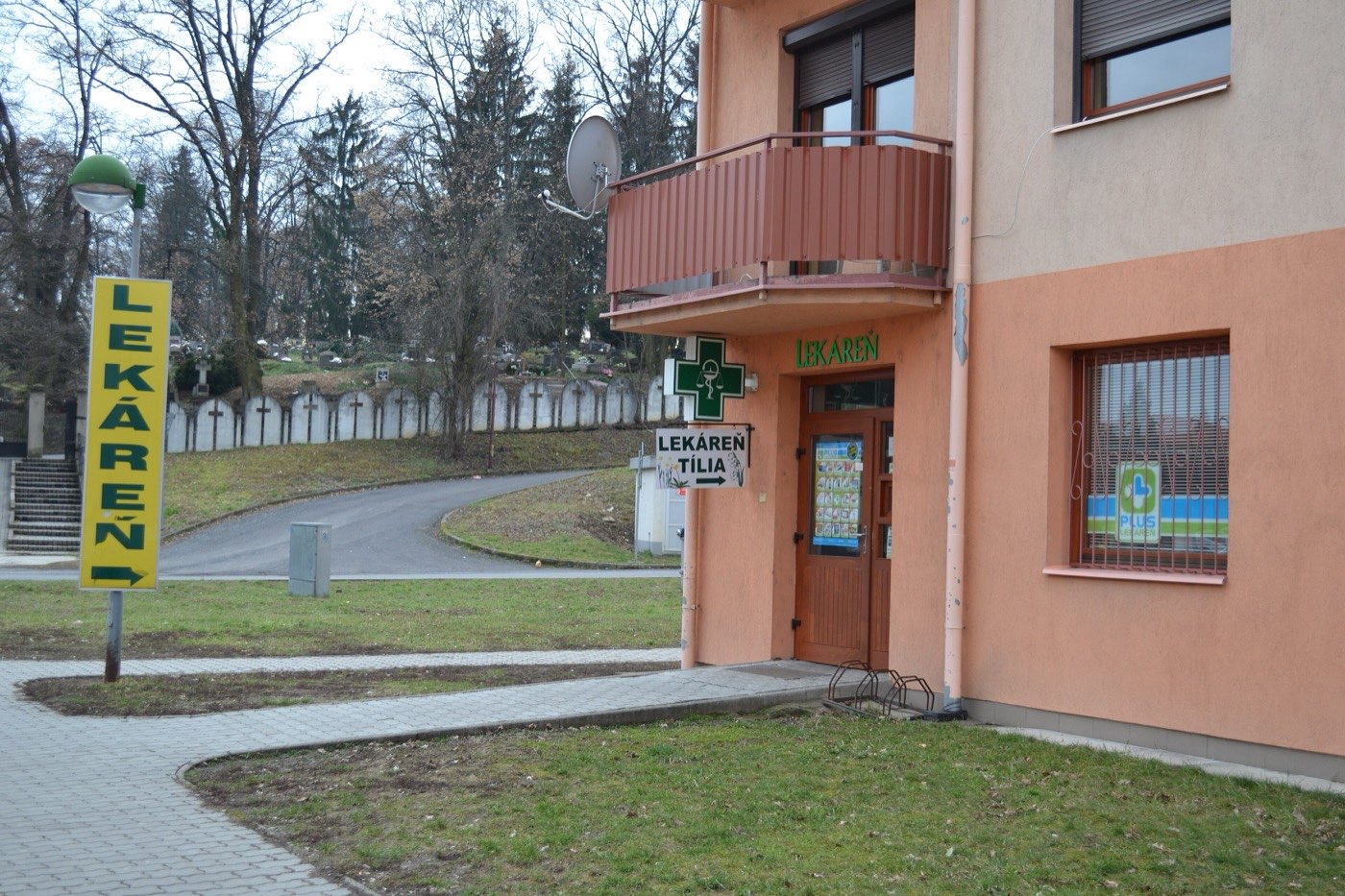
The pattern to remember is Czech -árna against Slovak -áreň, which turns up on every pharmacy and bakery. Street plates help too: Czech ulice, Slovak ulica. Czech Republic shop doors say otevřeno and zavřeno, while Slovakia uses otvorené and zatvorené, which also look close to the Croatian forms but carry an é at the end. The exit and entrance words are identical in both languages, so ignore them here.
Dutch, Afrikaans and German
Afrikaans grew out of Dutch, and German is the more distant cousin of both. All three share many sign words, so look at spelling habits as well as vocabulary.
| Sign word | Dutch | Afrikaans | German |
|---|---|---|---|
| Exit | Uitgang | Uitgang | Ausgang |
| Entrance | Ingang | Ingang | Eingang |
| Pharmacy | Apotheek | Apteek | Apotheke |
| Bakery | Bakkerij | Bakkery | Bäckerei |
| Centre | Centrum | Sentrum | Zentrum |
| Police | Politie | Polisie | Polizei |
| Station | Station | Stasie | Bahnhof |
| Street | Straat | Straat | Straße |
| "The" | de, het | die | der, die, das |
Dutch vs Afrikaans. Afrikaans writes y where Dutch writes ij (bakkery against bakkerij), s where Dutch writes c (sentrum against centrum) and -sie where Dutch writes -tie (polisie against politie). It also has a single article, die, so a sign full of die and no de or het is Afrikaans. In South Africa and Namibia, Afrikaans usually shares the sign with English. Dutch signs belong to the Netherlands and the Flemish half of Belgium; a Dutch shop door reads Open or Gesloten.
German. German capitalises every noun, so a sentence with capital letters scattered through the middle is German, not Dutch. Its sign words are also different: Ausgang and Eingang against uitgang and ingang, and Zentrum with a Z. A German door reads Geöffnet or Geschlossen. Germany and Austria use ß in Straße; see the letters guide for why Switzerland does not.
Malay and Indonesian
The letters guide already covers the big four differences: rumah sakit against hospital, toko against kedai, apotek against farmasi and kantor pos against pejabat pos. Transport and public signs add more, because the two standards spell many shared loanwords differently.
| Sign word | Malaysian Malay | Indonesian |
|---|---|---|
| Police | Polis | Polisi |
| Taxi | Teksi | Taksi |
| Bus | Bas | Bus |
| Station | Stesen | Stasiun |
| University | Universiti | Universitas |
| Toilet | Tandas | Toilet |
| Shop | Kedai | Toko |
If you see polis, teksi or stesen, you are in Malaysia, Singapore or Brunei, which use the Malaysian forms. Polisi, taksi, stasiun and universitas point to Indonesia. Both languages write jalan for street, so street plates alone do not help.
Romanian and Italian
Romanian is a Romance language, so its signs look Italian at a distance. Up close, the vocabulary and the letters ă, â, î, ș and ț give it away.
| Sign word | Romanian | Italian |
|---|---|---|
| Exit | Ieșire | Uscita |
| Entrance | Intrare | Entrata, Ingresso |
| Street | Strada | Via |
| Square | Piața | Piazza |
| Pharmacy | Farmacie | Farmacia |
| Bakery | Brutărie | Panificio, Forno |
| Open | Deschis | Aperto |
| Closed | Închis | Chiuso |
| Centre | Centru | Centro |
| Ending for "-tion" | -ție | -zione |
| Monday to Friday on hours boards | Lu, Ma, Mi, Jo, Vi | lun., mar., mer., gio., ven. |
Romanian street names use the noun with the article attached, so a plate reads Strada or Piața followed by the name, never Via or Piazza. Romanian signs belong to Romania and Moldova.
Quick checklist
- Spanish or Portuguese: Salida, calle and Lun to Vie against Saída, rua and Seg to Sex.
- Galician or Portuguese: rúa, praza, pechado and ñ against rua, praça, fechado and nh.
- Catalan or Spanish: carrer, plaça, sortida, tancat and i against calle, plaza, salida, cerrado and y.
- Danish or Norwegian: udgang and centrum against utgang and sentrum; stengt is Norwegian, lukket can be either.
- Swedish: utgång, öppet, stängt and öppettider.
- Croatian or Serbian: ljekarna, vlak and kruh against apoteka, voz and hleb.
- Slovenian: izhod, vhod, odprto, zaprto and lekarna.
- Czech or Slovak: lékárna and otevřeno against lekáreň and otvorené; Čt and Pá against Št and Pi.
- Dutch or Afrikaans: ij, c and -tie against y, s and -sie; die alone means Afrikaans.
- German: every noun capitalised, Ausgang, Eingang, Zentrum.
- Malaysia or Indonesia: polis, teksi, stesen against polisi, taksi, stasiun.
- Romanian or Italian: Ieșire, Strada and Închis against Uscita, Via and Chiuso.
When words mislead
Border regions mix languages on the same pole, and chains often keep their home-country name on every fascia. Tourist areas print exit and toilet signs in English. Old enamel plates can predate a spelling reform, and brand names keep spellings that the language itself dropped long ago. So treat one word as a hint and two independent words as an answer, then check something non-textual, such as the phone numbers and web domains described in phone codes, domains and currencies on signs, or the wider method in how to guess a country from a photo.
Practice
Start a free guest round at /try and, on every photo with text, find one of the words in these tables before you look at anything else. Country rounds are the fastest way to drill a single pair: try Portugal and then Spain, or Croatia and then Slovenia, and the spellings will start to jump out.