 GeoGuess
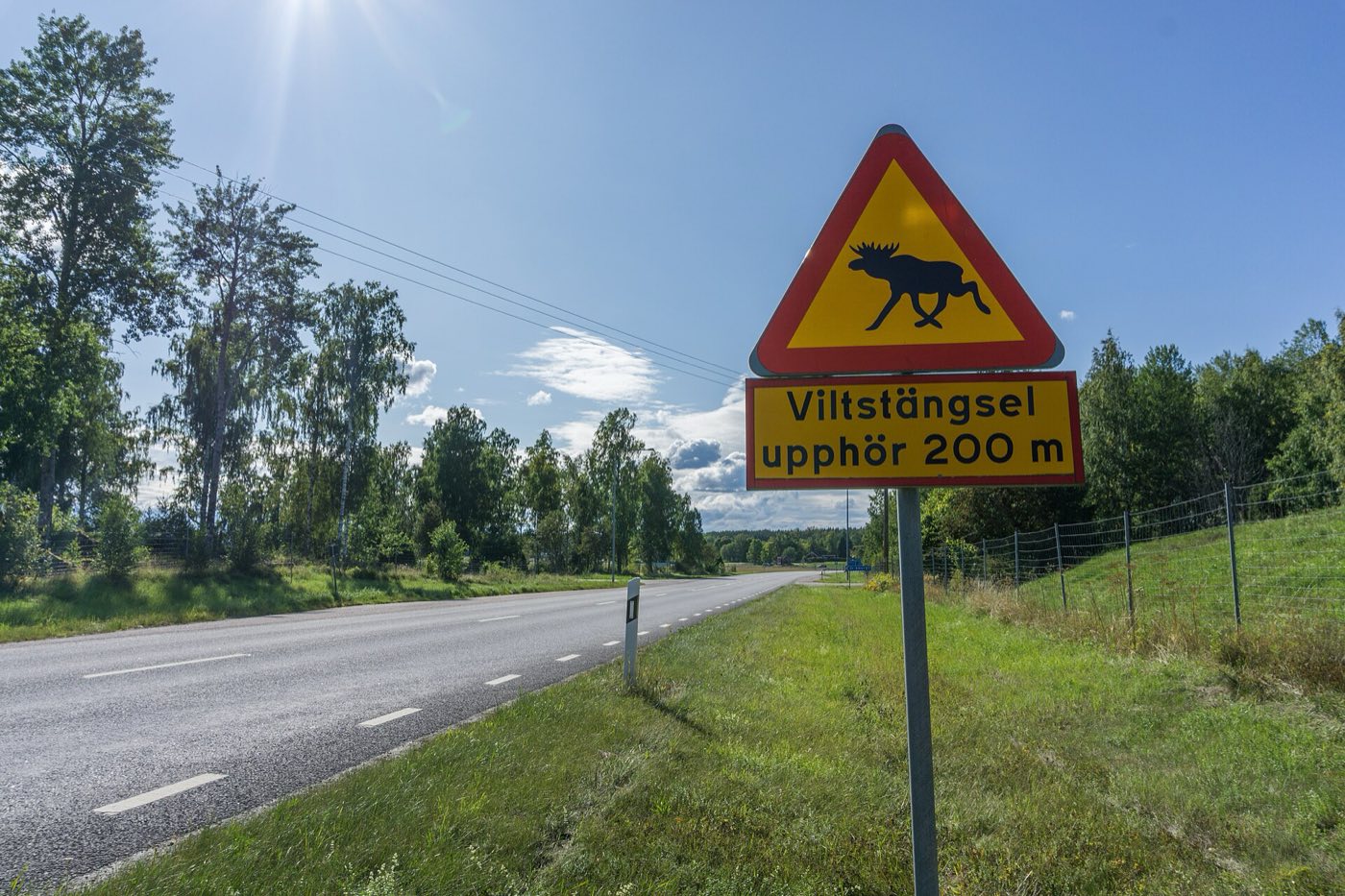
Start with the shape of the warning sign. A red-bordered triangle puts you in Europe or one of the many countries that follow the Vienna Convention on road signs; a yellow diamond points to the Americas, Australia, New Zealand, Ireland, Japan or parts of Southeast Asia. Then read the stop sign word, check whether speeds are in mph or km/h, and look at the colour of the direction signs and the line down the middle of the road. Two of those agreeing usually narrows a photo to a region, and three often to a single country.
Road signs are the most standardised objects in any street scene. Every country publishes rules for their shape, colour and lettering, so a single sign can carry more information than a whole hillside. This guide goes through the clues in the order you should check them.
The two big families: triangles and diamonds
Most of the world's warning signs belong to one of two traditions. The Vienna Convention on Road Signs and Signals (1968) is the basis for signs across Europe and in many countries beyond it. The Manual on Uniform Traffic Control Devices (MUTCD), first published in the United States in 1935, shaped signs across the Americas and in a handful of countries elsewhere.
The convention technically allows either shape for a danger warning: an equilateral triangle with a red border on a white or yellow background, or a yellow diamond with a black border. In practice the split by country is very clean, which is what makes it useful.
| Warning sign style | Where you see it |
|---|---|
| Red-bordered triangle, white background | Most of Europe, for example Germany, France, Italy, Spain, Norway and the United Kingdom, plus many other Vienna Convention countries |
| Red-bordered triangle, yellow background | Sweden, Finland, Iceland, Poland, Greece, South Korea |
| Black-bordered triangle, yellow background | China |
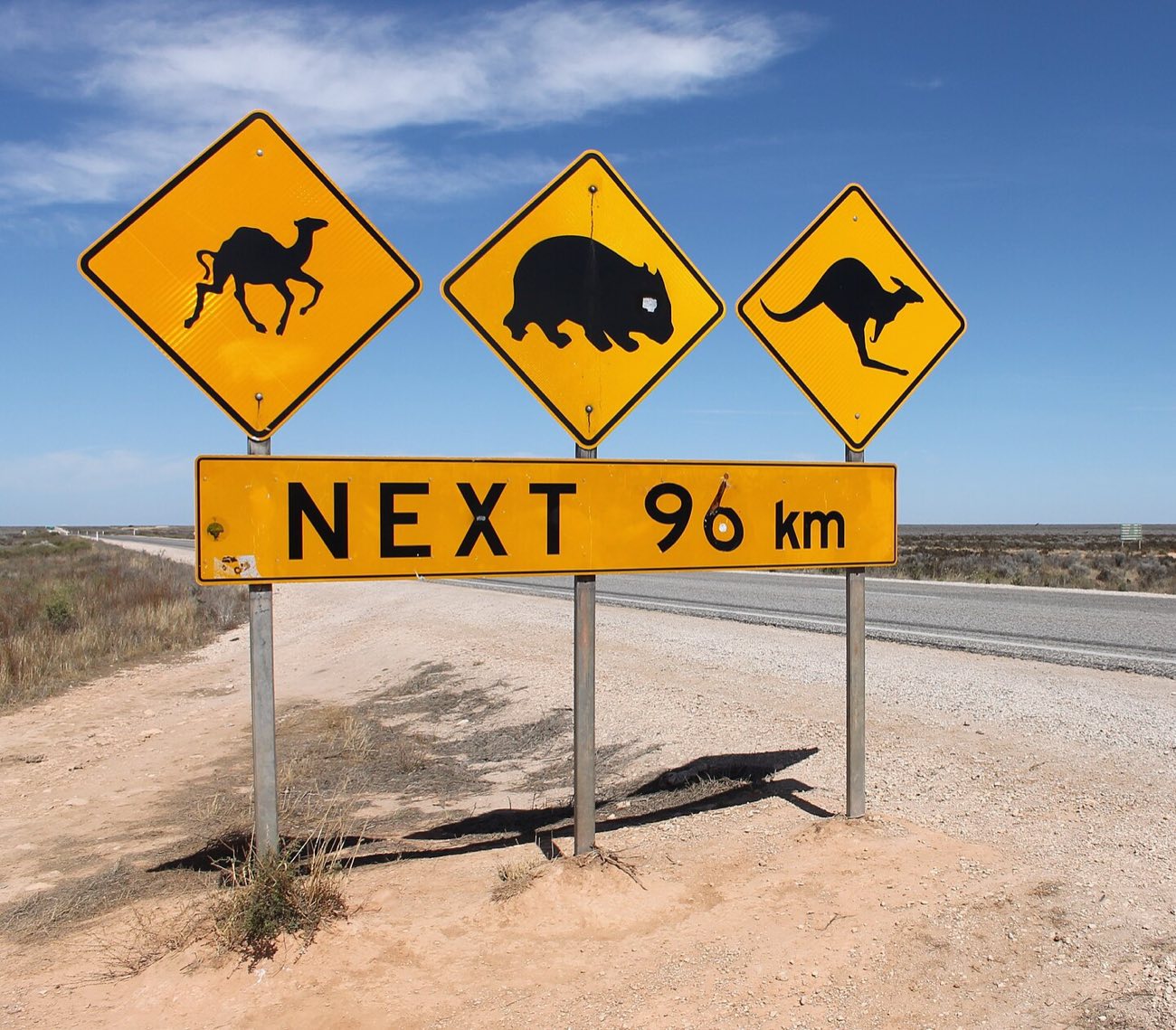
| Yellow diamond, black border | United States, Canada, Mexico and nearly all of Latin America, Australia, New Zealand, Ireland, Japan, Thailand, Malaysia, Indonesia |
A few details sharpen this table. Ireland is the only country in Europe with yellow diamond warnings, so a diamond next to a km/h sign and a Latin-script place name is almost always Irish. Norway keeps white triangles for permanent warnings and uses yellow ones only for temporary roadworks, so a yellow triangle there is a works zone, not a national style. Yugoslavia once used yellow-backed triangles too, and old ones still survive in remote parts of Slovenia, where they are slowly being replaced.
The Philippines, Taiwan and Vietnam mostly use red-bordered triangles, even though their direction signs look American. That mix is itself a clue.
Do not confuse the priority road diamond
Vienna Convention countries also use a diamond, but it means something completely different. The priority road sign is a white diamond with a yellow or orange square in the middle, standing on its point, and it tells you that you have right of way. It is common across continental Europe. It has no black symbol inside, so once you know it you will never mistake it for an American-style warning.
Japan follows its own rules
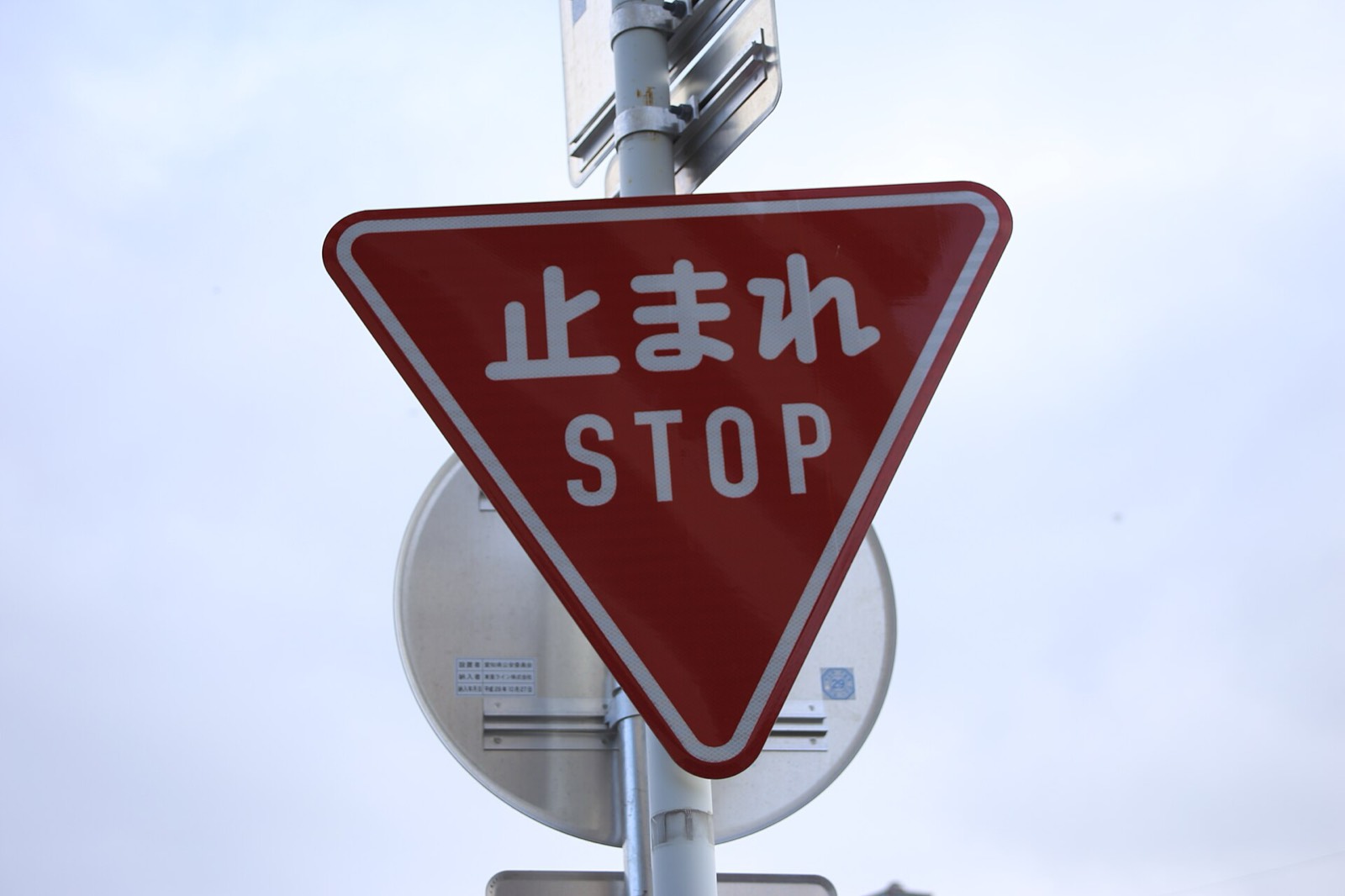
Japan is the clearest exception to every pattern above. Its warning signs are yellow diamonds based on the American design, but its regulatory signs are round and European-looking. The stop sign is not an octagon at all: it is a red inverted triangle reading 止まれ (tomare). The shape has been in use since 1963. A review that began in 2016 considered switching to an octagon but kept the triangle and made it bilingual, so current signs add the English word STOP underneath.
Direction signs follow a two-colour rule. Expressway signs are dark green with white text, while signs on national highways and in towns are dark blue. English names on newer signs use a typeface called Vialog, introduced in 2014.
Road markings in Japan use colour to show overtaking rules rather than direction. A white centre line means passing is allowed; a solid yellow centre line means it is not.
What the stop sign says
The red octagon is used in the greatest number of countries, so the shape alone tells you little. The word on it tells you a lot.
| Stop sign text | Where |
|---|---|
| STOP | Most of Europe regardless of language, including France, Spain, Portugal, Germany and Italy; the United States, English-speaking Canada, Australia, New Zealand, the UK and Ireland; Lebanon since 2019 |
| ARRÊT | Quebec, where it has been the standard since 1987 (STOP is also valid French, so you may still see it) |
| ALTO | Mexico and Central America |
| PARE | Spanish and Portuguese-speaking South America and Caribbean: Brazil, Argentina, Chile, Colombia, Peru, Uruguay, Venezuela, Cuba, the Dominican Republic, Puerto Rico and others |
| DUR | Turkey |
| قف (qif) | Arabic-speaking countries, sometimes with French or English added, as in Algeria and Tunisia |
| ایست (ist) | Iran and Afghanistan |
| A raised hand, no word | Israel and Palestine |
| 止まれ and STOP, on a triangle | Japan |
| 停 | China and Taiwan; Hong Kong adds STOP |
| 정지 and STOP | South Korea |
| หยุด | Thailand |
| BERHENTI | Malaysia and Brunei |
| СТОП or STOP | Russia and other Russian-speaking countries |
The ALTO and PARE split is one of the most useful single-word clues on the planet. Both are Spanish, but ALTO means you are north of Colombia and PARE means you are south of it, or in the Spanish-speaking Caribbean. Note that Spain itself uses STOP.
Israel deserves a second look: the octagon carries no Hebrew word at all, only a white hand. If you see Hebrew text on a red octagon, look again.
Miles or kilometres
Almost every country posts speeds in kilometres per hour. The short list that uses miles per hour is worth learning by heart:
| Uses mph for speed limits | |
|---|---|
| Independent countries | United States, United Kingdom, Antigua and Barbuda, the Bahamas, Belize, Dominica, Grenada, Saint Kitts and Nevis, Saint Lucia, Saint Vincent and the Grenadines, the Marshall Islands, Micronesia, Palau, and occasionally Liberia |
| British territories and Crown dependencies | Anguilla, the British Virgin Islands, the Cayman Islands, the Falkland Islands, Montserrat, Saint Helena, Turks and Caicos, Guernsey, Jersey, the Isle of Man |
| US territories | American Samoa, Guam, the Northern Mariana Islands, Puerto Rico, the US Virgin Islands |
Two former mph countries trip people up. Canada went metric in the 1970s, with the speed limit change complete by 1977. Ireland switched on 20 January 2005, and to avoid confusion every Irish speed limit sign prints "km/h" under the number. A speed sign that spells out km/h in Europe is therefore a strong Ireland clue. Puerto Rico is a curious mix: speed limits are in mph but distance signs are in kilometres.
Most speed signs do not print a unit at all, so the number in a red ring is not proof either way. A UK roundel showing 30 and a German roundel showing 30 look identical. Among countries with American-style signs, those that print km/h on speed limits include Brazil, Mexico, Peru, Panama, Indonesia, Ireland and parts of Canada. The American speed sign is a white rectangle reading SPEED LIMIT above the number, which is a clue in itself.
Direction sign colours
Direction signs are where countries disagree most, and where it pays to check per country rather than assume a pattern. In Europe the main question is whether motorways are green or blue.
| Motorway signs | Countries |
|---|---|
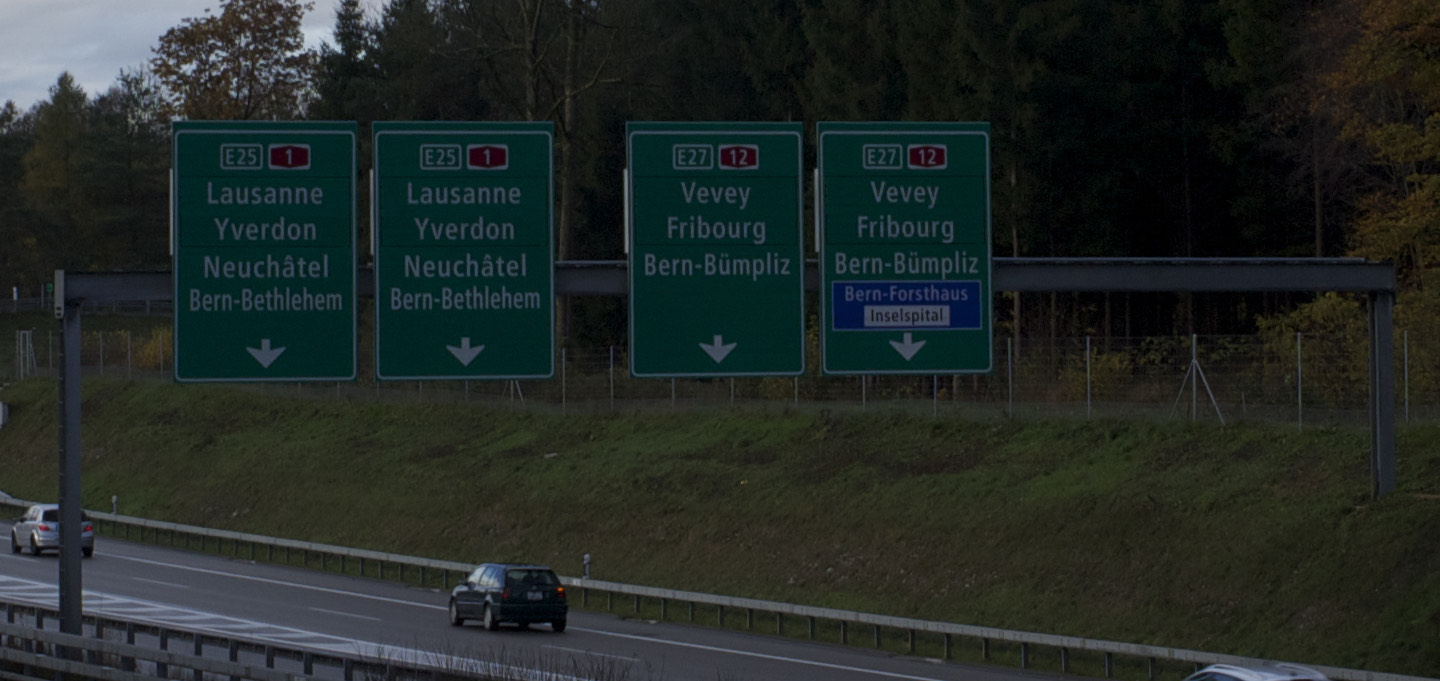
| White on green | Italy, Switzerland, Sweden, Denmark, Finland, Greece, Croatia, Slovenia, Serbia, Bosnia and Herzegovina, Montenegro, Albania, Bulgaria, Romania, the Czech Republic, Slovakia, Lithuania, Turkey, Russia, Ukraine, Belarus, Armenia |
| White on blue | Germany, France, the United Kingdom, Ireland, Spain, Portugal, the Netherlands, Belgium, Austria, Poland, Hungary, Norway |
The colour of ordinary main roads is the second half of the clue, and it is often the reverse of the motorway colour:
- Italy and Switzerland: green for motorways, blue for main roads. In Switzerland white signs mark smaller roads.
- France: blue for autoroutes, green for the main routes between major towns, white for everything else. It is close to the mirror image of Italy.
- United Kingdom: blue motorways, green primary routes with yellow route numbers, white non-primary roads.
- Ireland: blue motorways, green national roads with yellow route numbers.
- Germany: blue Autobahn signs, but most other main roads use black on yellow.
- Norway: blue on motorways, yellow everywhere else.
- Sweden: green on motorways, blue on ordinary roads.
- Denmark: green for destinations reached by staying on the motorway, blue on motorway signs that lead off it, and red lettering on white on ordinary main roads.
- Poland: blue motorways, green expressways and main roads.
Belgium has its own twist: signs pointing to a motorway are green, while signs on the motorway are blue.
Outside Europe, green guide signs are the norm in the United States and Canada, and Australia follows the same practice. Japan uses green for expressways and blue for other roads, while in Malaysia and Thailand green is reserved for toll expressways. A green motorway sign therefore does not mean Italy on its own; pair it with the warning sign shape and the language.
Centre line colours
The line down the middle of a two-way road is one of the quickest clues in a landscape shot, and one of the easiest to get wrong. The colour rules are not as tidy as the sign families, so treat this table as the verified core rather than a world map.
| Centre line separating opposing traffic | Where |
|---|---|
| Yellow | United States, Canada and almost all of North and South America; South Korea; Norway |
| White | The United Kingdom, Ireland, the Netherlands and most of Europe; Australia; Israel; Hong Kong; Chile (yellow in snowy regions); Venezuela |
| White when passing is allowed, yellow when it is not | Japan, Finland, New Zealand, Argentina and Uruguay |
A few notes. Norway is the standout in Europe: yellow lines separate opposing traffic and run along the left edge of paved roads, so a yellow centre line on a European-looking road with white triangles is almost certainly Norwegian. Russia may use yellow instead of white for the centre line, so do not rule it out on yellow alone. Austria used yellow centre lines in the past but began replacing them with white from 1995. Ireland pairs a white centre line with yellow edge lines, which is distinctive in Europe.
Yellow markings in Europe usually mean something temporary. Germany, France, Italy, the Netherlands and Spain all use yellow for roadworks lines, so a bright yellow line on an Italian motorway may simply be a works zone.
Sign typefaces
Lettering is a subtle clue, but a few typefaces are so closely tied to their countries that they are worth knowing.
| Typeface | Where |
|---|---|
| Transport | United Kingdom, designed by Jock Kinneir and Margaret Calvert between 1957 and 1963; also Ireland, Iceland, Malta, Portugal and, in modified form, Greece |
| DIN 1451 | Germany, the Czech Republic, Latvia, Greek motorways, and road signs across the Southern African Development Community, including South Africa |
| Highway Gothic (FHWA Series) | United States, and derived versions in Brazil, Colombia, Thailand, the Philippines, Turkey and Central America |
| Clearview | Some US states (interim approval from 2004, withdrawn in 2016 and reinstated in 2018), British Columbia, and Indonesia as its official typeface since 2014 |
| Caractères | France |
| Alfabeto Normale | Italy, San Marino, Albania |
| Carretera Convencional | Spain |
| Tratex | Sweden |
| ASTRA-Frutiger | Switzerland since 2003; Liechtenstein still uses the older SNV |
| Tern | Austria since 2013 and new signs in Slovakia |
Two of these are useful as tie-breakers. The Netherlands uses ANWB lettering derived from the American Highway Gothic, so Dutch signs can look faintly American despite their European shapes. And DIN 1451 lettering on signs in a country that drives on the left points towards southern Africa rather than Germany. If driving side is part of your read, the guide to countries that drive on the left covers it in detail.
Putting the clues together
Signs work best in combination. Some pairings that narrow things fast:
- Yellow diamond and km/h printed on the sign, in a European-looking town: Ireland.
- Yellow diamond and mph: the United States or one of the small mph countries in the Caribbean and Pacific.
- Yellow diamond, km and English text, driving on the left: Australia, New Zealand or Ireland. Irish place names and yellow edge lines pick out Ireland, and New Zealand's yellow no-passing centre lines help split the other two.
- Yellow diamond and PARE: South America. Yellow diamond and ALTO: Mexico or Central America.
- Yellow-backed triangle and a green motorway sign: Sweden, Finland or Greece; the script and letters settle it. Our guide to telling scripts apart helps with the last step.
- White triangle, blue motorway sign and black-on-yellow main road signs: Germany.
- White triangle and a yellow centre line: Norway is the first candidate.
- Red inverted triangle with text on it: Japan.
For the full method that puts signs alongside script, landscape and buildings, see the pillar guide on guessing a country from a photo.
Quick checklist
- Warning sign shape. Triangle or diamond? If triangle, white or yellow inside, red or black border?
- Stop sign word. STOP, ARRÊT, ALTO, PARE, DUR, Arabic, a hand, or a Japanese triangle.
- Speed unit. Is mph possible? Is km/h actually printed on the sign?
- Direction sign colour. Green or blue on the motorway, and what colour are the ordinary roads?
- Centre line. Yellow, white, or both depending on overtaking?
- Lettering. Transport, DIN, Highway Gothic or something narrower.
- Cross-check. Two agreeing clues give a region; three usually give a country.
Practice
Road signs reward repetition more than almost any other clue, because the same few shapes and colours keep coming back. Play a free round as a guest at /try, no account needed, and before you place a pin, name the sign family and the line colour out loud. Each country page also has its own round, for example Ireland or Sweden, so you can drill one sign system at a time until it becomes automatic.