 GeoGuess
Five parts of the world share a Mediterranean climate, and they look alike in photos: the Mediterranean Basin itself, California, central Chile, the Western Cape of South Africa and the south-west and south of Australia. To tell them apart, look past the dry hills and the scrub to the plants that only grow wild in one region (proteas and restios in the Cape, banksias and grass trees in Australia, the fat-trunked Chilean wine palm, blue oaks in California, cork oaks around the western Mediterranean), then check the cheap clues: South Africa and Australia drive on the left, the other three regions mostly on the right, and the language and number plates finish the job.
The reason they look so similar is climate, not coincidence. All five sit roughly between 30 and 45 degrees of latitude, mostly on the western side of a continent, with wet, mild winters and long, hot, dry summers. Plants that survive that pattern end up looking alike wherever they evolved: small, hard, evergreen leaves, a grey-green colour, a dense waist-high scrub that burns and regrows, and grass that turns gold by early summer.
The five regions at a glance
| Region | Scrub name | Native giveaways | Planted lookalikes | Driving side |
|---|---|---|---|---|
| Mediterranean Basin | Maquis, garrigue | Cork oak, holm oak, stone pine, Italian cypress, wild olive | Eucalyptus, agave, prickly pear | Right (Cyprus and Malta: left) |
| California | Chaparral | Blue oak, coast live oak, manzanita, chamise | Eucalyptus, olive, Italian cypress, palms | Right |
| Central Chile | Matorral | Chilean wine palm, quillay, columnar Echinopsis cactus | Monterey pine, eucalyptus | Right |
| Western Cape | Fynbos | Proteas, ericas, restios | Stone pine, Monterey pine, eucalyptus | Left |
| South-west and southern Australia | Kwongan, mallee | Banksias, grass trees, eucalypts | Olive, Italian cypress | Left |
The planted column is the trap: these regions have spent two centuries swapping trees, so one famous tree is rarely enough on its own.
The trap: trees that travelled
Eucalyptus is weak evidence
Eucalyptus is native to Australia, with only a handful of species reaching New Guinea, Indonesia and the Philippines. It is also one of the most widely planted trees on Earth. Australians brought it to California during the Gold Rush in the 1850s, and it now lines highways and old windbreaks across the state. Portugal and Spain grow it in plantations for pulpwood, it spreads as an invasive tree in South Africa, and Chile has large eucalyptus plantations alongside its pine.
So a tall gum tree tells you almost nothing between these five regions. What does count is eucalyptus as natural vegetation: low, many-stemmed gums sprouting from one base (the mallee form), or open eucalypt woodland over native shrubs, rather than a neat row of tall trees beside a road.
Pines and cypresses go everywhere too
The tall, narrow Italian cypress is native to the eastern Mediterranean and Iran, but it has been planted as an ornamental for thousands of years, including in California, southern Australia and the south-west of South Africa. The stone pine, the umbrella-shaped pine of Roman postcards, is native to the Mediterranean, but it is naturalised in South Africa and New South Wales and common in Californian and Australian parks. In the Western Cape, stone pines are said to date back to French Huguenot settlers in the late 1600s.
The strangest case runs the other way. The Monterey pine grows wild in only three small coastal patches of California and on two Mexican islands, yet it is the main plantation tree in Chile, New Zealand and Australia and is widely grown in South Africa and northern Spain. A dark, regimented pine plantation is more likely to be in Chile than anywhere near Monterey.
Olives, agaves and prickly pears
Olives belong to the Mediterranean, where the ten largest producers grow about 95 per cent of the world's crop, but the tree has been grown in California since Franciscan missionaries planted it in the eighteenth century and is now farmed in Chile, Argentina, Peru and Australia too. Agave and prickly pear cactus are both Mexican plants that have gone wild around the Mediterranean, and agave has also naturalised in southern California and Australia. None of them should move your guess much.
Mediterranean Basin
The basin is the largest of the five, so it is the default when nothing else points elsewhere. Its scrub comes in two heights. Maquis is the tall, dense version, a thicket of holm oak, strawberry tree, lentisk, myrtle and rock rose. Garrigue is the low, open version on thin limestone soil, where aromatic herbs grow between bare rock.
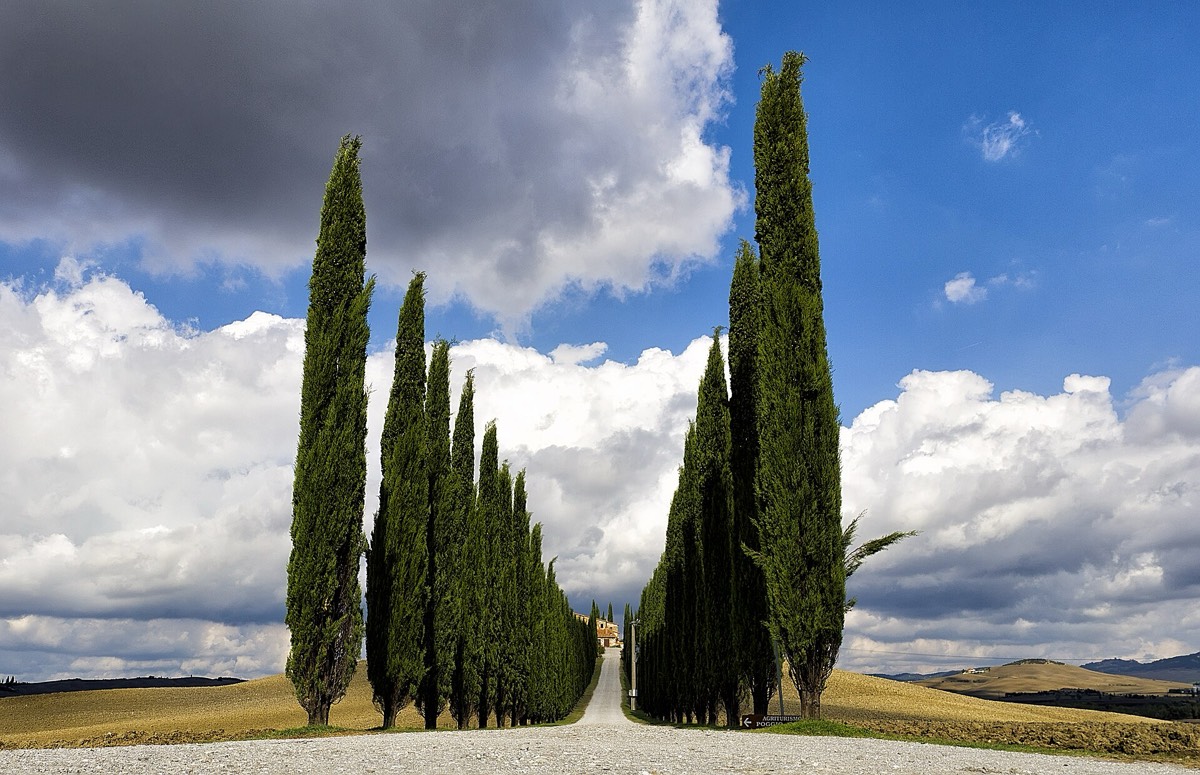
The strongest native tree clues:
- Cork oak. A thick-barked evergreen oak of Portugal, Spain, Morocco, Algeria, Tunisia and the Tyrrhenian side of Italy. Freshly stripped trunks are a striking reddish brown that darkens with time, and southern Portugal is the centre of cork production.
- Holm oak, stone pine and cypress together, especially when they are scattered across terraced hillsides and old stone walls rather than planted in a garden.
- Old olive groves with gnarled, wide trunks on terraces. Young olive orchards are planted in all five regions, but very old terraced groves point to the basin.
The buildings usually settle it before the plants do. Southern Spain's pueblos blancos are villages of whitewashed walls and red or brown tiled roofs. The Greek Cyclades use white, cube-shaped houses with flat roofs. Most of Italy, southern France and the Iberian interior use terracotta roof tiles on stone or rendered walls. The scripts help too: Greek letters mean Greece or Cyprus, Arabic points to North Africa or the Levant, and Hebrew means Israel.
Inside the basin, only Cyprus and Malta drive on the left. Gibraltar looks British but drives on the right.
California
California's hills in summer are the most recognisable gold in this whole set, and that gold is mostly not Californian. The state's grasslands are now dominated by annual grasses brought from the Mediterranean Basin, so the grass itself is shared with Spain. The trees growing out of it are the giveaway.
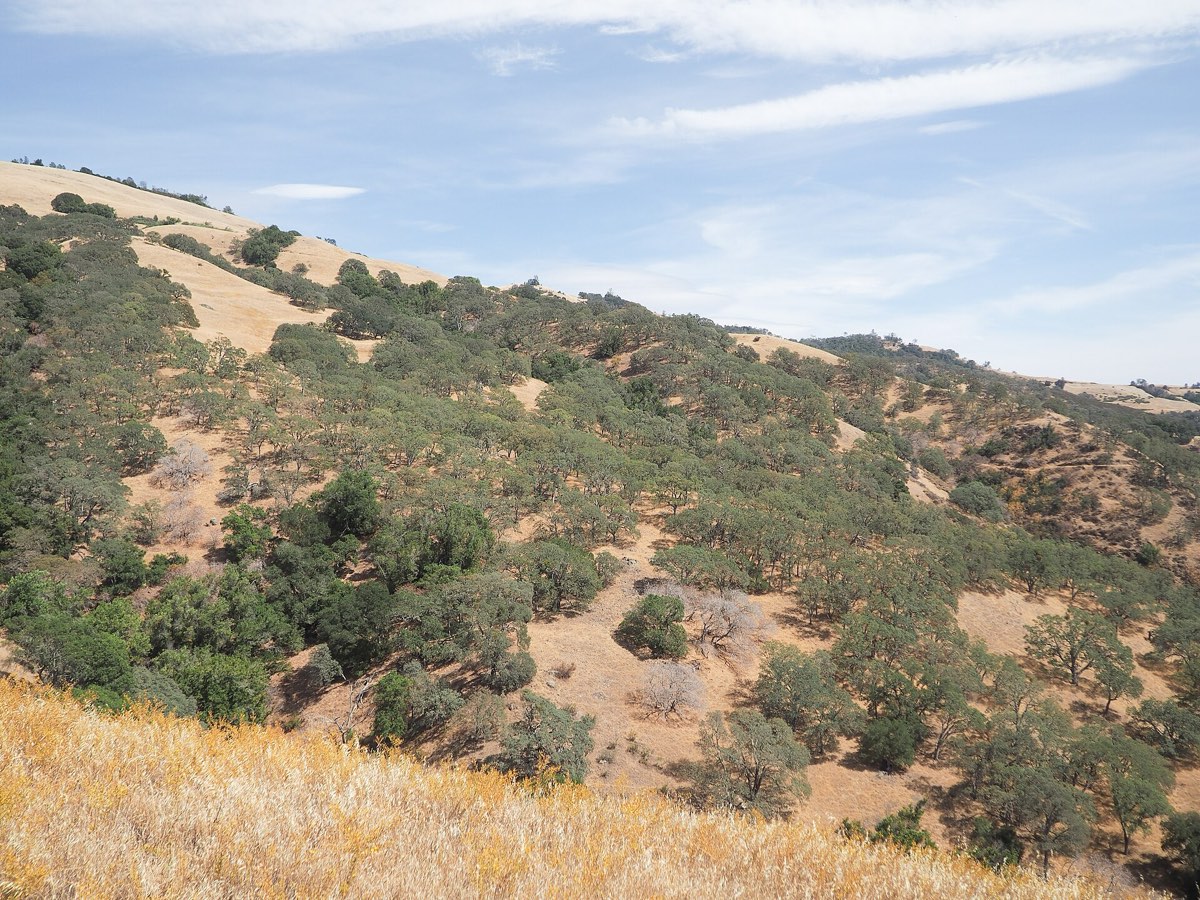
- Blue oak is found only in California, scattered across the foothills of the Coast Ranges and the Sierra Nevada. It drops its leaves in winter and is the most drought-tolerant of the state's deciduous oaks.
- Coast live oak is a broad, dense evergreen oak with a twisted trunk, growing within about 100 kilometres of the Pacific from Mendocino County to northern Baja California.
- Chaparral is California's version of maquis: chamise, ceanothus, toyon, scrub oak and manzanita. Manzanita is the one to learn. It has smooth, red bark, and almost every species of it grows in the California region.
Buildings can mislead. After the 1915 Panama-California Exposition in San Diego, the Spanish Colonial Revival style spread across the state: stucco walls, low-pitched clay tile roofs and arcades. Santa Barbara adopted the style for its whole town centre after its 1925 earthquake. A photo of a white wall and a red tile roof can therefore come from California as easily as from Andalusia. Look for wooden utility poles and the yellow centre lines used in North America.
The plate is a quick confirmation: white, with blue characters and the word California in red script across the top. English signs, miles per hour and right-hand traffic place it in the United States.
Central Chile
Chile's Mediterranean zone is a narrow strip in the middle of the country, roughly between 32 and 37 degrees south, holding Santiago, Valparaíso and most of the population. The matorral is very similar to chaparral and maquis at first glance, but a few plants are unique to it.
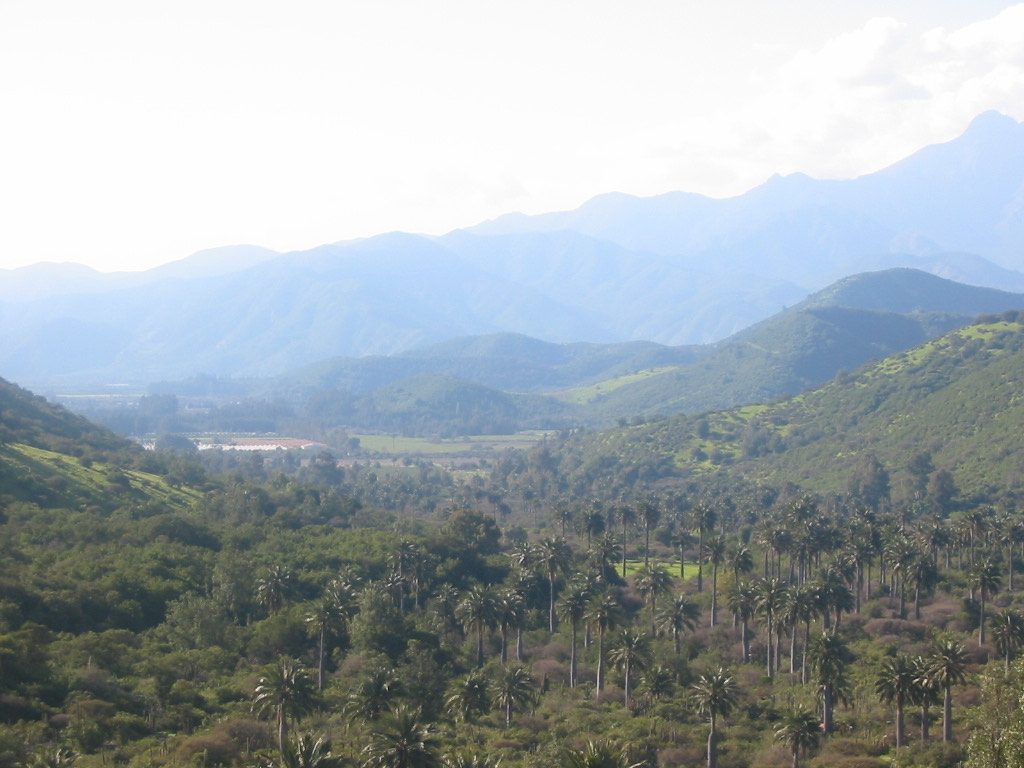
- Chilean wine palm. Endemic to a small area of central Chile, from about 32 to 35 degrees south. Its trunk is famously thick, often wider in the middle than at the base, and it grows in groves on scrubby hillsides. Ornamental palms appear in every one of these regions, but a natural palm grove among native scrub is a Chilean picture.
- Columnar cacti in the scrub. Echinopsis chiloensis is a branching, tree-like cactus up to about six metres tall, growing on hillsides and in Andean foothills across central Chile. Tall native cacti mixed into Mediterranean scrub rule out the other four regions.
- Quillay and litre are typical matorral shrubs, along with spiky Puya bromeliads on rocky slopes.
The setting helps. Santiago sits in a valley between the Coastal Range and the high Andes, so a wall of very tall, often snow-capped mountains behind a dry scrubby valley is a strong hint. Valparaíso climbs dozens of steep hillsides with brightly painted houses and old funiculars.
Spanish signs and right-hand traffic narrow it to the Spanish-speaking world. Chilean plates are black on white with four letters and two numbers on newer cars and the word CHILE at the bottom.
Western Cape, South Africa
The fynbos is the richest of the five scrublands. The wider Cape region holds somewhere around 9,000 plant species, most of them found nowhere else, and fynbos runs along a coastal belt about 100 to 200 kilometres wide.
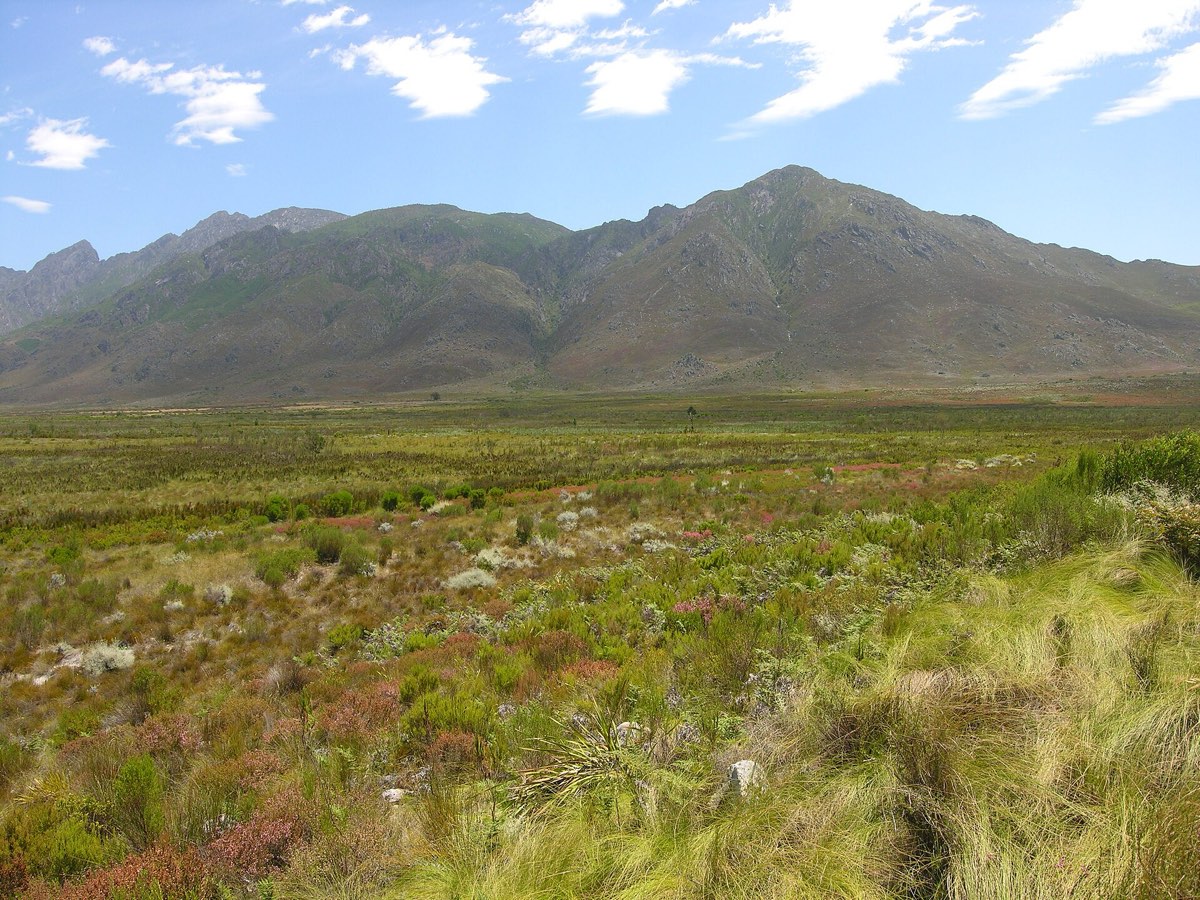
The three plant groups to recognise:
- Proteas and their relatives, with large, showy flower heads. About nine in ten Protea species are found only in the Cape region, and the king protea is South Africa's national flower.
- Ericas, small-leaved heaths, often pink or red in flower. The fynbos holds more Erica species than the rest of the world combined.
- Restios, grass-like plants with rush-like stems, growing in tufts. They are more varied in the fynbos than anywhere else, though they also occur in south-west Australia.
Fynbos looks finer and more uniform than maquis or chaparral, with few trees. Where you do see trees on Cape hillsides, they are often introduced pines or eucalyptus.
The architecture is the clearest single clue in this whole guide. Cape Dutch farmhouses have whitewashed walls, thatched roofs, large wooden windows with shutters and a grand, ornately rounded gable over the front door, often on an H-shaped plan. They cluster in the winelands around Stellenbosch, Paarl and Franschhoek. Modern copies exist on some wine estates in Western Australia and New Zealand, so check the rest of the scene.
Traffic keeps left. The most common home language in the Western Cape is Afrikaans, followed by isiXhosa and English, so Afrikaans words on signs are a strong pointer. Number plates registered in the province are black on white, and registrations begin with C, with CA for Cape Town.
South-west and southern Australia
Australia's Mediterranean climate covers the south-west corner of Western Australia around Perth and the southern fringe around Adelaide. The south-west is a global biodiversity hotspot with more than 8,000 native plant species, about half of them found nowhere else.
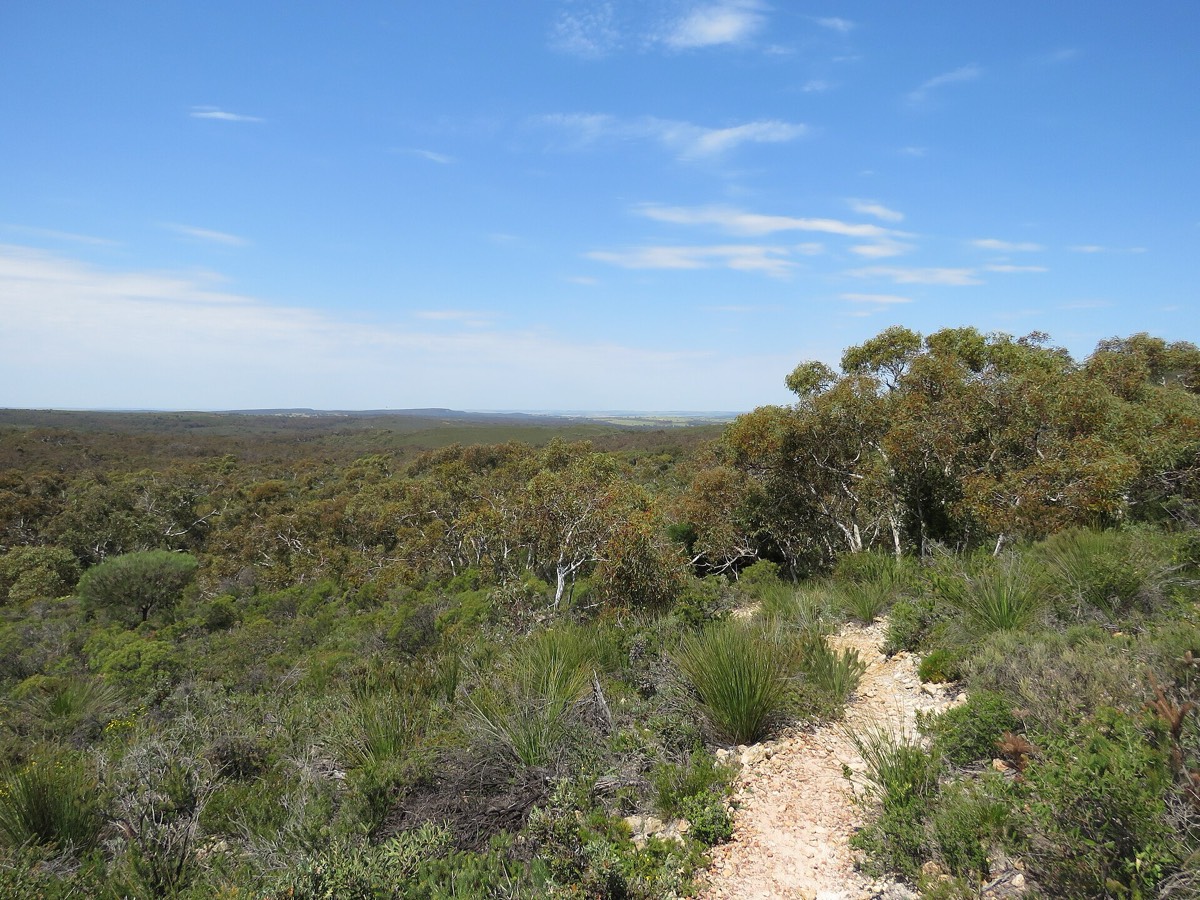
- Kwongan is the south-west's low, hard-leaved shrubland and heath, which holds about 70 per cent of the region's plant species. It is easily mistaken for fynbos.
- Banksias have cylindrical flower spikes that dry into woody cones. Over 90 per cent of banksia species occur only in south-west Western Australia, and all but one are found only in Australia.
- Grass trees (Xanthorrhoea) grow a dark, rough trunk topped by a tuft of stiff, grass-like leaves and, in flower, a tall spike. The genus is found only in Australia.
- Mallee is the many-stemmed eucalypt growing from a single woody base, forming low woodland across the dry south, most extensively in South Australia.
Telling kwongan from fynbos is the hardest call in this set, because both are fine-leaved, flowering heaths on poor sandy soils and both contain restios. Look for eucalypts growing as part of the native vegetation, banksias and grass trees, and the wide, empty roads of the Australian countryside. In the Cape, fynbos often climbs high, bare sandstone mountains; much of the kwongan grows on flatter country, such as the Geraldton Sandplains north of Perth.
Corrugated iron roofs are common on Australian houses and farm buildings. Around Adelaide, the Stobie pole, two steel beams with concrete between them, is a strong South Australia clue. Plates carry the state name, and traffic keeps left.
Southern or northern hemisphere
When the plants are ambiguous, the sun can split the five in two. California and the Mediterranean Basin lie north of the Tropic of Cancer, so the midday sun is always in the southern part of the sky. Central Chile, the Western Cape and south-west Australia all lie south of the Tropic of Capricorn, where the midday sun is always to the north. If you can tell which way the shadows point and which way the camera faces, you have halved the options. The guide to reading the hemisphere from a photo covers the method in detail.
Quick checklist
- Driving side first. Left means South Africa, Australia, Cyprus or Malta. Right rules out the Cape and Australia.
- Language next. English could be California, the Cape or Australia. Spanish could be Spain or Chile. Afrikaans means South Africa. Greek means Greece or Cyprus.
- Ignore single eucalyptus, cypress, stone pine, olive, agave and prickly pear. They have all been planted across the other regions.
- Look for wild-only plants: proteas and ericas (Cape), banksias and grass trees (Australia), wine palm groves and tall cacti in scrub (Chile), blue oaks and red-barked manzanita (California), cork oaks (western Mediterranean).
- Read the buildings. Rounded white gables and thatch mean the Cape. White cubes with flat roofs mean the Greek islands. Red tile roofs could be Spain, Italy or California.
- Check plates: a blue EU band means a European Union country, a red California script means California, black on white with CHILE means Chile.
- Use the sun if nothing else works: midday sun in the north means one of the three southern regions.
These steps slot into the general method in how to guess a country from a photo. The full left-hand traffic list is in countries that drive on the left, and plate details are in the licence plates guide.
Practice
Dry hills and scrub are among the hardest scenes to place. Play a free round as a guest at /try and, every time you see gold grass or grey-green scrub, name the region before you look at the map. Country rounds such as Chile, South Africa or Australia let you drill one region's scrub at a time.